Events/Seminars

From Thalesians
Jump to: navigation, search

Contents

Introduction

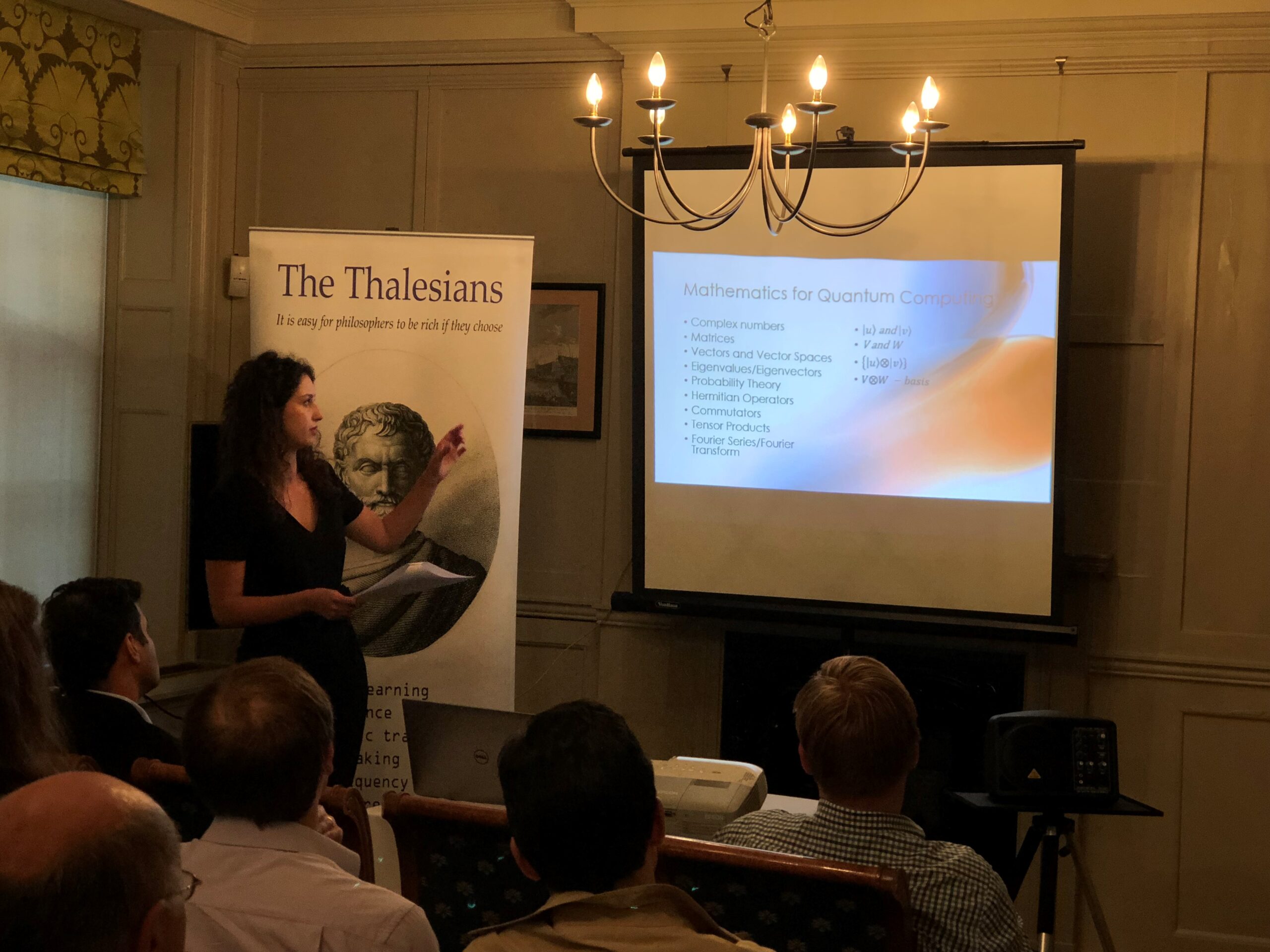
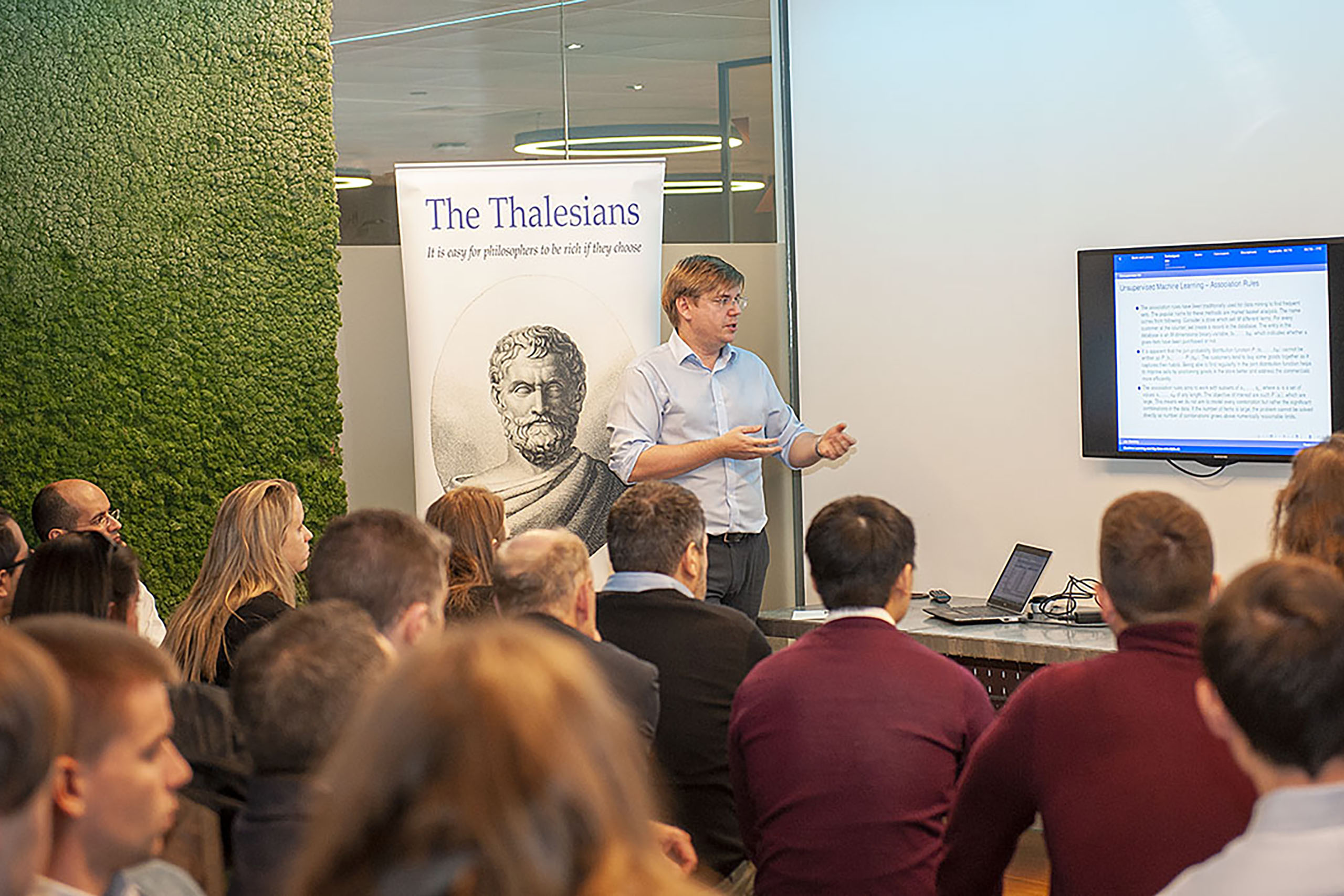
The Thalesians Quantitative Finance Seminars are a series of talks for dedicated finance professionals to learn about state-of-the-art quantitative finance methodology from seasoned speakers.

We provide a unique opportunity for finance professionals to further their careers by sharing expertise and cross-pollinating new methodology and ideas in the wider context of the finance industry.

Come along to our seminars in Canary Wharf (LDN), Midtown Manhatten (NYC) or downtown San Francisco (SF) and join us for a quantitative finance talk by a guest speaker followed by discussions.

Videos

Videos of some of the London talks are available: both Flash streaming videos and downloadable in MP4 format for iPod/iTunes.

Venues

London, UK

Private meeting rooms at Dockmaster's House
1 Hertsmere Road
Canary Wharf
London
E14 8JJ

Venue home page: http://www.dockmastershouse.com/

Directions from Canary Wharf tube station (A) to Dockmaster's House (B)

New York City, USA

NYU Kimmel Center
Room 914, 60 Washington Square South
NY 10012, NY
or
lower level conference room 014/015
New York Public Library: Science Industry and Business Library
188 Madison Avenue, New York, NY

San Francisco, USA

Location: 5th floor, GGU
536 Mission Street
San Francisco, CA

Cost

The London seminars charge £15 at the door for events to cover the venue hire and other expenses. Admittance to the IAFE/Thalesians NYC seminars is strictly by online registration only and is $25 for non-IAFE members.

Registration

  • For UK talks, please contact Paul Bilokon, paul, who is at thalesians.com, to reserve your place and/or sign up to our official seminar list.
  • For US talks, please contact Matthew Dixon, matthew, who is at thalesians.com, to reserve your place and/or sign up to our official seminar list.
  • However, the quickest and easiest way to register (and pay online) is on http://www.meetup.com/thalesians/

Forthcoming Seminars

Thalesian Seminar (London) — Patrick S. Hagan — Arbitrage Free SABR

Date and Time

7:30 p.m. on Wednesday, 22nd May, 2013.

Venue

Private rooms at Dockmaster's House, Canary Wharf, London, UK.

Meetup.com

You can register for this event and pay online on Meetup.com: http://www.meetup.com/thalesians/events/119389682/

Abstract

Smile risk is often managed using the explicit implied volatility formulas developed for the SABR model. These asymptotic formulas are not exact, and this can lead to arbitrage for low strike options. Here we provide an alternative method for pricing options under the SABR model: We use asymptotic techniques to reduce the SABR model from two dimensions to one dimension. This leads to an effective one dimensional forward equaltion for the probability density which has the same asymptotic order of accuracy as the explicit implied volatility formulas. We obtain arbitrage free option prices by numerically solving this PDE. The implied volatilities obtained from the numerical solutions closely match the explicit implied volatility curves, apart from a boundary layer at very low rates. For very low rate environments, or for very low strikes, the implied absolute (normal) volatility dips downwards, closely matching market observations. We also show how negative rates can be accommodated by replacing the Fβ factor with (F + a)β.

Speaker

Patrick Hagan has made several fundamental contributions to mathematical finance, particularly in the area of interest rate derivatives modelling, where he pioneered the SABR volatility model - now the de-facto approach for including stochastic volatility within the LIBOR market model. Patrick Hagan received his Ph.D and B.S in Applied Mathematics from Caltech. Over the years he has worked at Bloomberg and several banks designing trading systems for fixed income, credit, and foreign exchange derivatives, as well as developing the component models, calibration methods, and numerical algorithms. He served at Head of Quantitative Analytics and Chief Investment Officer at JP Morgan. Before entering finance he was Deputy Director of the CNLS and a member of the Computer Research and Applications group at Los Alamos National Laboratory. He has also worked at Exxon Science Laboratories, and has taught at Caltech, Stanford, the Institute for Mathematics and its Applications, and NYU.

Video

To be published here

Slides

To be published here

Resources

  • N/A

Thalesian Seminar (San Francisco) — Jesse Davies — Risk Model Imposed Manager-to-Manager Correlation

Jesse Davies

Date

Wednesday, June the 5th, 2013

Agenda

4:15-4:30: Registration

4:30-5:30: Talk

5:45-7:30: Thalesians Dinner with the speaker

Venue

Rm 527, 101 Howard Street, University of San Francisco

Meetup.com

You can register for this quantitative finance talk of the Thalesian SF seminar on Meetup.com: http://events.thalesians.com/events/114818282/

Abstract

Do risk models create correlations between investment managers? There is a great deal of concern among investment managers and their investors regarding the correlation between different investment manager's strategies. The concern arises due to investor's needs to create a diversified portfolio of strategies as well as additional stability issues that come with "crowded trades". The focus of these concerns is invariably on the alpha signals developed by different managers with no worry spent on the other pieces of the investment process, however. Correspondingly, the majority of research time spent by investment managers is in the alpha signal generation process with risk modeling and portfolio construction often left to either off-the-shelf techniques or even outsourced to third-party providers. This talk demonstrates that the usage of common risk models itself creates correlation between manager's portfolios, identifies the reason for this correlation and its limiting case, offers an intuitive mathematical interpretation of the problem, and analyzes the results of employing some proposed solutions.

Speaker

Jesse Davis is a Director in the Global Macro Research group at First Quadrant, a $17B systematic institutional investment manager. His primary responsibility there is in leading and performing alpha research for First Quadrant's global macro portfolios, and he previously also served as Director of the Risk Office overseeing risk across all First Quadrant products. He has previously been an alpha researcher in a US equity market neutral hedge fund as well as founder of a software company dedicated to delivering quantitative tools to discretionary investors. Mr. Davis earned Math, Electrical Engineering, and Computer Science degrees from MIT in 2002 and became a CFA Charterholder in 2010.

IAFE-Thalesians Seminar (New York) — Prof. Philip Protter — Can one detect a bubble in real time?

Philip Protter

Agenda

May 15th, 2013:

5:45 PM Registration

6:00 PM Seminar Begins

7:30 PM Reception

Venue

NYU Kimmel Center, Room 914, Kimmel Center, 60 Washington Square South, NY 10012, NY

Registration

You can register for this event on Meetup here.

Registration fees are complimentary for IAFE members. Go to the IAFE-Thalesians site for further details.

Abstract

Recent advances in the mathematical modeling of financial bubbles has led to the observation that bubble detection often boils down to determining if, under the risk neutral measure, a process is a strict local martingale or a true martingale. Bubbles are fairly easily recognizable after the fact, once they have run their course, but it is often difficult to detect their presence in real time. There are few tools available to distinguish a martingale from a strict local martingale, and it seems that determining which is the case from data is a delicate procedure. Indeed, one can argue that in principle it is impossible. Nevertheless in this talk we will explain how, in a special case, there is hope that one can determine when a bubble is present, and when it is not, in real time. The talk is based on joint work with Robert Jarrow and Younes Kchia.

Speaker

Philip Protter works in probability theory, with specialties in stochastic calculus, weak convergence and limit theorems, stochastic differential equations and Markov processes, stochastic numerics, and mathematical finance. He is the author of one book and the co-author of three more, and he has published more than 100 research papers. He was a visiting member of the Institute for Advanced Study in 1978, a National Science Foundation/Centre National de la Recherche Scientifique (NSF/CNRS) Exchange Scientist (to France) in 1980, and a Fulbright - Tocqueville Distinguished Chaired Professor in Paris in 2007. He gave the inaugural R. Von Mises Lecture at Humboldt Universität, Berlin, in 2007 and the Bullitt Lecture at the University of Louisville in 2009. This Spring he will give the Karl Menger Lecture at IIT in Chicago. He is a Fellow of the Institute of Mathematical Studies (IMS). Currently he is a Professor of Statistics at Columbia University. Before Columbia, he held positions at Cornell University, Purdue University, and Duke University.

IAFE-Thalesians Seminars

The IAFE-Thalesians Seminar Series is a joint effort on the part of the IAFE and the Thalesians. The goal of the series is to provide a forum for the exchange of new ideas and results related to the field of quantitative finance. This goal is accomplished by hosting seminars where leading practitioners and academics present new work, and following the seminars with a reception to facilitate further interaction and discussion. The seminar series is limited to IAFE and Thalesians members only.

Past Seminars

Thalesian Seminar (London) — Claudio Albanese — The FVA-DVA puzzle: Completing Markets with Collateral Trading Strategies

Claudio Albanese

Date and Time

7:30 p.m. on Wednesday, 8th May, 2013.

Venue

Private rooms at Dockmaster's House, Canary Wharf, London, UK.

Meetup.com

You can register for this event and pay online on Meetup.com:

Abstract

In the aftermath of the crisis, valuations of fixed income derivatives have significantly diverged from the principles of arbitrage-free pricing. Discrepancies arise because of the incompleteness of collateral trading markets which lack of reverse REPO contracts for cash upgrades accepting OTC derivatives as general collateral. This circumstance forces banks to implement sub-optimal super-replication strategies generating wealth transfers across the bank capital structure from shareholders to senior debt holders. The present value of the wealth transfer is the FVA.

To avoid losses to shareholders, the bank cannot realistically carry out a Modigliani-Miller arbitrage which would involve buying back all its debt liabilities using equity capital or shorting its own credit. Transferring FVA costs to clients is a suboptimal solution which engenders systemic arbitrage opportunities and drives the financial system away from Pareto optimality.

In this talk, we discuss market-completing collateral trading strategies which solve the problem at the root. They reduce or eliminate the FVA and DVA. They also exploit the form of bank capital structure arbitrage revealed in current derivative valuations. Similar strategies also mitigate counterparty credit risk for banks and reduce or eliminate CVA capital charges.

Speaker

Claudio Albanese is a Visiting Professor at the Financial Mathematics Group at King's College and an independent consultant at Global Valuation Ltd. He received his doctorate in Physics from ETH Zurich, following which he held post-doctoral positions at New York University and Princeton University. He was Associate Professor in the Mathematics Department of the University of Toronto and then Professor of Mathematical Finance at Imperial College London.

Video

To be published here

Slides

To be published here

Resources

  • N/A

IAFE-Thalesians Seminar (New York) — Prof. Paul Glasserman — How Likely is Contagion in Financial Networks?

Paul Glasserman

Agenda

April 23rd, 2013:

5:45 PM Registration

6:00 PM Seminar Begins

7:30 PM Reception

Venue

NYU Kimmel Center, Room 914, Kimmel Center, 60 Washington Square South, NY 10012, NY

Registration

You can register for this event on Meetup here.

Registration fees are complimentary for IAFE members. Go to the IAFE-Thalesians site for further details.

Abstract

Interconnections among financial institutions create potential channels for contagion and amplification of shocks to the financial system. We estimate the extent to which interconnections increase expected losses, under a wide range of shock distributions. An essential and novel feature of our analysis is that it assumes only minimal information about network topology. This is important because financial networks are opaque. We find that expected losses from network effects are surprisingly small without substantial heterogeneity in bank sizes and a high degree of reliance on interbank funding. They are also small unless shocks are magnified by some mechanism beyond simple spillover effects; these include bankruptcy costs, fire sales, and mark-to-market revaluations of assets. We illustrate the results with data on the European banking system. This is joint work with Peyton Young of Oxford.

Speaker

Paul Glasserman is the Jack. R Anderson Professor of Business at Columbia Business School, where he serves as research director of the Program for Financial Studies. His research focuses on risk management, derivative securities, and portfolio selection. In 2011-2012, he was on leave from Columbia and working with the Office of Financial Research in Washington, which led to the research presented in this talk. He has previously held visiting positions at Princeton University, NYU, and the Federal Reserve Bank of New York, and he worked at Bell Labs before joining Columbia in 1991. He earned an A.B. from Princeton in 1984 and Ph.D. from Harvard in 1988.

IAFE-Thalesians Seminars

The IAFE-Thalesians Seminar Series is a joint effort on the part of the IAFE and the Thalesians. The goal of the series is to provide a forum for the exchange of new ideas and results related to the field of quantitative finance. This goal is accomplished by hosting seminars where leading practitioners and academics present new work, and following the seminars with a reception to facilitate further interaction and discussion. The seminar series is limited to IAFE and Thalesians members only.

Thalesian Seminar (London) — Daniel Kuhn — Scenario-Free Stochastic Programming: Methodology and Applications

Daniel Kuhn

Date and Time

7:30 p.m. on Wednesday, 24th April, 2013.

Venue

Private rooms at Dockmaster's House, Canary Wharf, London, UK.

Meetup.com

You can register for this event and pay online on Meetup.com: http://events.thalesians.com/events/114762492/

Abstract

Traditional optimization models only involve deterministic parameters whose values are assumed to be known precisely. However, many practical decision problems involve uncertain parameters such as future prices and resource availabilities. It has been shown that treating these parameters as deterministic quantities can lead to severely suboptimal or even infeasible decisions. Stochastic programming overcomes this deficiency by faithfully treating the uncertain parameters as random variables. Stochastic programs are usually solved by approximating the random variables with a finite number of scenarios. Such scenario-based approaches suffer from a curse of dimensionality, that is, the optimization models scale exponentially with the number of uncertain parameters. In this talk, we present a scenario-free approximation to stochastic programming. Instead of discretizing the random variables, we employ a low-dimensional representation of the problem's decision variables. The optimization model scales polynomially with the number of uncertain parameters and is computationally tractable. We illustrate how this technique can be used to solve large-scale problems in operations management and energy economics.

Speaker

Daniel Kuhn is a Senior Lecturer in the Department of Computing at Imperial College London. His current research interests are focused on the development of efficient computational methods for the solution of stochastic and robust optimization problems and the design of approximation schemes which ensure their computational tractability. This theoretical work is primarily application-driven, the main application areas being energy systems, finance and engineering.

Video

To be published here

Slides

To be published here

Resources

  • N/A

Thalesian Seminar (London) — Gary Wong — Addressing emerging collateral issues and CVA Trading issues through counterparty party credit risk transfer: a more in-depth look at securitization schemes and Margin Lending

Gary Wong

Date and Time

7:30 p.m. on Wednesday, 10th April, 2013.

Venue

Private rooms at Dockmaster's House, Canary Wharf, London, UK.

Meetup.com

You can register for this event and pay online on Meetup.com: http://events.thalesians.com/events/111518332/

Abstract

While Dodd Frank and Basel III pushes OTC derivatives market towards full collateralization and central clearing, there are many structural reasons where a significant number of counterparty are still rooted in unsecured trades, incurring CVA, FVA and regulatory capital charges. A host of problematic business and operational issues are emerging, including swap pricing (CVA + FVA charge), extending credit line for new business counterparties, CSA and collateral requirements, calculating collateral funding costs and their allocation, CVA risk and hedging, and finally capital ratio and RoC. A number of banks tried different securitization schemes to transfer these counterparty credit risk to outside investors, to very limited success. I will explore some promising variation on these securitization schemes, which can be viewed as intermediate step leading towards Margin Lending. Margin lending is a new construct or new financial intermediary function, which lend collateral to portfolio of unsecured counterparties, transforming unsecured trades to fully collateralised trades to the banks, thus avoiding all the problematic issues mentioned before. At the heart of margin lending is a securitization process, which is based on new technology, providing transparent quantitative credit and market risk analysis for all the market participants. Although a number of investors already express interests in participating in the scheme, there are a number of conceptual and practical issues raised. I will examine these issues and suggest practical implementation strategy to address them.

Speaker

Dr. Gary Wong is the CEO of Ipotecs, providing advisory service focusing on collateralization of derivatives trades with unsecured counterparty through margin/collateral lending operation. The process reduces banks’ counterparty risk exposure and capital requirements, and lowers the cost of OTC derivatives business for both banks and counterparty, and creates investment opportunity for a whole spectrum of investors through securitization of counterparty credit risk.

Prior to starting Ipotecs, he spent many years trading complex structured derivatives and developing risk management techniques and infrastructure to control risks. His latest role was Managing Director and Business Head of Structured Trading Group in Mitsubishi UFJ Securities International (MUSI), responsible for the P&L and business development of all structured derivatives.

His responsibilities included trading and structuring desk, risk management desk, quantitative modelling team and technology infrastructure team; he also has close working relationships with risk and operational groups, ranging from Model Validation, Risk Control, Product Control to Operations. He and his groups developed sophisticated models and high-end technology as a platform for financial trading and risk reporting, and for many years was the most profitable group in MUSI.

Prior to this, he was a swap trader, and developed the exotic derivatives trading capability in Mizuho International. Before that, he was in JP Morgan Asset Management, working on asset allocation models, and IT infrastructure including real-time derivatives and options pricing system.

He has both BSc (1st class) and PhD in Physics from Imperial College, London University.

Video

To be published here

Slides

To be published here

Resources

  • N/A

IAFE-Thalesians Seminar (New York) — Prof. Paul Glasserman — How Likely is Contagion in Financial Networks?

Paul Glasserman

Agenda

April 23rd, 2013:

5:45 PM Registration

6:00 PM Seminar Begins

7:30 PM Reception

Venue

NYU Kimmel Center, Room 914, Kimmel Center, 60 Washington Square South, NY 10012, NY

Registration

You can register for this event on Meetup here.

Registration fees are complimentary for IAFE members. Go to the IAFE-Thalesians site for further details.

Abstract

Interconnections among financial institutions create potential channels for contagion and amplification of shocks to the financial system. We estimate the extent to which interconnections increase expected losses, under a wide range of shock distributions. An essential and novel feature of our analysis is that it assumes only minimal information about network topology. This is important because financial networks are opaque. We find that expected losses from network effects are surprisingly small without substantial heterogeneity in bank sizes and a high degree of reliance on interbank funding. They are also small unless shocks are magnified by some mechanism beyond simple spillover effects; these include bankruptcy costs, fire sales, and mark-to-market revaluations of assets. We illustrate the results with data on the European banking system. This is joint work with Peyton Young of Oxford.

Speaker

Paul Glasserman is the Jack. R Anderson Professor of Business at Columbia Business School, where he serves as research director of the Program for Financial Studies. His research focuses on risk management, derivative securities, and portfolio selection. In 2011-2012, he was on leave from Columbia and working with the Office of Financial Research in Washington, which led to the research presented in this talk. He has previously held visiting positions at Princeton University, NYU, and the Federal Reserve Bank of New York, and he worked at Bell Labs before joining Columbia in 1991. He earned an A.B. from Princeton in 1984 and Ph.D. from Harvard in 1988.

IAFE-Thalesians Seminars

The IAFE-Thalesians Seminar Series is a joint effort on the part of the IAFE and the Thalesians. The goal of the series is to provide a forum for the exchange of new ideas and results related to the field of quantitative finance. This goal is accomplished by hosting seminars where leading practitioners and academics present new work, and following the seminars with a reception to facilitate further interaction and discussion. The seminar series is limited to IAFE and Thalesians members only.

Thalesian Seminar (London) — Iain Clark — Commodity Option Pricing: Energy Derivatives — Oil, Gas and Coal

Iain Clark

Date and Time

7:30 p.m. on Wednesday, 27th March, 2013.

Venue

Private rooms at Dockmaster's House, Canary Wharf, London, UK.

Meetup.com

You can register for this event and pay online on Meetup.com: http://events.thalesians.com/events/110138722/

Abstract

Commodities as an asset class have experienced somewhat of a surge in interest over the past ten years, driven largely by an increase in demand from newly industrialising countries, but also by investor appetite for investment opportunities that are weakly correlated with more liquid financial markets. Commodities can be very broadly categorised into three major areas - metals, energy and agricultural. In this talk, I shall introduce the typical financial instruments encountered by energy quants (quantitative analysts), such as futures, options on futures, swaps and Asians. It will be seen that market quotes exist which can be used to calibrate implied volatility surfaces, which are used for option pricing.

Examples will be given to show how futures curves and volatility surfaces typically evolve, using the benchmark WTI crude oil as an example (we discuss natural gas and gasoline also).

While I shall discuss some aspects of pricing and theory, the talk will be primarily descriptive and will be accessible to anyone with an interest in resource markets. The talk is the first in a small series of sneak previews of the material in my new book Commodity Option Pricing: A Practitioner's Guide, due to appear in print with Wiley Finance later in 2013.

Speaker

Iain Clark has over 13 years experience as a front office quant. He has worked as Head of FX Quantitative Analysis at Unicredit, at Standard Bank as Head of FX and Commodities Quantitative Analysis, Dresdner Kleinwort, Lehman Brothers, BNP Paribas and JP Morgan.

Iain has a PhD in applied mathematics from Queensland University and a MSc in financial mathematics from Edinburgh and Heriot-Watt Universities. He still writes his own code.

His book Foreign Exchange Option Pricing: A Practitioner's Guide was published in November 2010 by Wiley Finance.

Video

To be published here

Slides

To be published here

Resources

  • N/A

Thalesian Seminar (London) — Attila Vrabecz — Financial data mining with kdb+/q

Attila Vrabecz

Date and Time

7:30 p.m. on Wednesday, 13th March, 2013.

Venue

Private rooms at Dockmaster's House, Canary Wharf, London, UK.

Meetup.com

You can register for this event and pay online on Meetup.com: http://events.thalesians.com/events/107619162/

Abstract

This talk is going to showcase kdb+'s data mining and analytical capabalities on large scale financial data.

Speaker

Attila Vrabecz has been working with kdb+ over seven years and is a leading figure in the kdb community. He has been working at multiple different sized firms on both the buy and sell side.

Video

To be published here

Slides

To be published here

Resources

  • N/A

IAFE-Thalesians Seminar (New York) — Dr. Marcos López de Prado — Concealing the trading footprint by determining the Optimal Execution Horizon (OEH)

MarcosLopezdePrado

Agenda

March 20th, 2013:

5:45 PM Registration

6:00 PM Seminar Begins

7:30 PM Reception

Venue

NYU Kimmel Center, Room 914, Kimmel Center, 60 Washington Square South, NY 10012, NY

Registration

You can register for this event on Meetup here.

Registration fees are complimentary for IAFE members. Go to the IAFE-Thalesians site for further details.

Abstract

Market Makers adjust their trading range to avoid being adversely selected by Informed Traders. Informed Traders reveal their future trading intentions when they alter the Order Flow. Consequently, Market Makers’ trading range is a function of the Order Flow imbalance. The Optimal Execution Horizon (OEH) algorithm takes into account order imbalance to determine the optimal participation rate, i.e. how much volume a trader needs to conceal his trading intentions. Paper: http://ssrn.com/abstract=2038387.

Speaker

Marcos López de Prado is the Head of Quantitative Trading & Research at Hess Energy Trading Company, the trading arm of Hess Corporation, a Fortune 100 company. Before that, Marcos was Head of Global Quantitative Research at Tudor Investment Corporation, where he also led High Frequency Futures Trading and several strategic initiatives. Marcos joined Tudor from PEAK6 Investments, where he was a Partner and ran the Statistical Arbitrage group at the Futures division. Prior to that, he was Head of Quantitative Equity Research at UBS Wealth Management, and a Portfolio Manager at Citadel Investment Group.

In addition to his 15+ years of investment management experience, Marcos has received several academic appointments, including Postdoctoral Research Fellow of RCC at Harvard University, Visiting Scholar at Cornell University, and Research Affiliate at Lawrence Berkeley National Laboratory (U.S. Department of Energy’s Office of Science). He holds a Ph.D. in Financial Economics (Summa cum Laude, 2003), a Sc.D. in Mathematical Finance (Summa cum Laude, 2011) from Complutense University, is a recipient of the National Award for Excellence in Academic Performance by the Government of Spain (National Valedictorian, Economics, 1998), and was admitted into American Mensa with a perfect score. Marcos is a scientific advisor to Enthought's Python projects (NumPy, SciPy), and a member of the editorial board of the Journal of Investment Strategies (Risk Journals). His research has resulted in three international patent applications, several papers listed among the most read in Finance (SSRN), publications in the Review of Financial Studies, Mathematical Finance, Journal of Risk, Journal of Portfolio Management, etc. His current Erdös number is 3, with a valence of 2.

IAFE-Thalesians Seminars

The IAFE-Thalesians Seminar Series is a joint effort on the part of the IAFE and the Thalesians. The goal of the series is to provide a forum for the exchange of new ideas and results related to the field of quantitative finance. This goal is accomplished by hosting seminars where leading practitioners and academics present new work, and following the seminars with a reception to facilitate further interaction and discussion. The seminar series is limited to IAFE and Thalesians members only.

Thalesian Seminar (London) — Saeed Amen — FX trading using market positioning in FX

Saeed Amen

Date and Time

7:30 p.m. on Wednesday, 27th February, 2013.

Venue

Private rooms at Dockmaster's House, Canary Wharf, London, UK.

Meetup.com

You can register for this event and pay online on Meetup.com: http://events.thalesians.com/events/105370522/

Abstract

In this talk, we introduce the concept of market positioning within FX. Understanding market positioning is a very important part of trading. It is often something that market participants talk about, but less often do investors analyse it in a more quantitative manner which is our aim. We discuss ways of determining market positioning within FX. We examine the relationship between positioning and price action. Furthermore, we look at methods of assessing speculators P&L, and see what impact it has on price action within FX.

Speaker

Saeed Amen is a Managing Director at Thalesians Ltd.

Saeed started his career at Lehman Brothers. He worked on the FX desk developing systematic trading models for both G10 and EM and was part of the team who developed the MarQCuS suite of models. He was also responsible for a systematic FX prop trading book and conducted research around high frequency FX including economic events. He currently works at Nomura as an Executive Director in Quantitative Strategy, also in FX, developing their model infrastructure and helping run systematic FX prop risk. He graduated from Imperial College with a first class honours master's degree in Mathematics and Computer Science.

Video

To be published here

Slides

To be published here

Resources

  • N/A

IAFE-Thalesians Seminar (New York) — Dr. Alexander Eydeland — Models in Commodity Markets

AlexEydeland

Agenda

February 12th, 2013:

5:45 PM Registration

6:00 PM Seminar Begins

7:30 PM Reception

Venue

NYU Kimmel Center, Room 802, 60 Washington Square South, NY 10012, NY

Registration

You can register for this event on Meetup here.

Registration fees are complimentary for IAFE members. Go to the IAFE-Thalesians site for further details.

Abstract

In this presentation we will focus on unique properties of commodity markets and prices, and describe approaches to modeling physical assets such as storage and power plants.

Speaker

Dr. Alexander Eydeland is Managing Director at Morgan Stanley in charge of global commodities strategies. His previous positions include Head of Research at Mirant Corp., vice president with Lehman Brothers and Fuji Capital Markets, and associate professor of mathematics at the University of Massachusetts. Eydeland holds a Ph.D. degree in Mathematics from Courant Institute of Mathematical Sciences. His papers on risk management, scientific computing, optimization and mathematical economics have appeared in a number of major publications and he has lectured extensively on these subjects throughout the United States, Europe, and Japan. Eydeland is a co-author (with K. Wolyniec) of the book "Energy and Power Risk Management" published in 2002 by Wiley and Co.

IAFE-Thalesians Seminars

The IAFE-Thalesians Seminar Series is a joint effort on the part of the IAFE and the Thalesians. The goal of the series is to provide a forum for the exchange of new ideas and results related to the field of quantitative finance. This goal is accomplished by hosting seminars where leading practitioners and academics present new work, and following the seminars with a reception to facilitate further interaction and discussion. The seminar series is limited to IAFE and Thalesians members only.

IAFE-Thalesians Seminar (New York) — Prof. Robert Almgren — Option Hedging with Market Impact

RobertAlmgren

Agenda

January 14th, 2013:

5:45 PM Registration

6:00 PM Seminar Begins

7:30 PM Reception

Venue

NYU Kimmel Center, Room 914, 60 Washington Square South, NY 10012, NY

Registration

You can register for this event on Meetup here.

Registration fees are complimentary for IAFE members. Go to the IAFE-Thalesians site for further details.

Abstract

We consider the problem of a trader hedging a large options position. We use a realistic proportional market impact cost model, as is commonly used in optimal execution problems, rather than the bid-ask spread model which has been previously used. We also include overnight risk, which is important for an intraday hedge position. Our solutions solve a "pursuit problem", in which the actual hedge position moves smoothly in the direction of the perfect Black-Scholes hedge. We also obtain an expression for the modified volatility of the underlying caused by the hedge activity: if the hedger is long the option then volatility decreases and conversely if he is short. (Joint work with Michael Li, Princeton University.)

Speaker

Robert Almgren, co-founder of Quantitative Brokers, providing agency algorithmic execution and cost measurement in interest rate markets, and Fellow in the Mathematics in Finance Program at New York University. Until 2008, Dr Almgren was a Managing Director and Head of Quantitative Strategies in the Electronic Trading Services group of Bank of America Securities. From 2000-2005, he was a tenured Associate Professor of Mathematics and Computer Science at the University of Toronto, and Director of its Master of Mathematical Finance program. Before that, he was an Assistant Professor of Mathematics at the University of Chicago and Associate Director of the Program on Financial Mathematics. Dr. Almgren holds a B.S. in Physics and Mathematics from the Massachusetts Institute of Technology, an M.S. in Applied Mathematics from Harvard University and a Ph.D. in Applied and Computational Mathematics from Princeton University. He has an extensive research record in applied mathematics, including papers on optimal trading, transaction cost measurement, and portfolio construction.

IAFE-Thalesians Seminars

The IAFE-Thalesians Seminar Series is a joint effort on the part of the IAFE and the Thalesians. The goal of the series is to provide a forum for the exchange of new ideas and results related to the field of quantitative finance. This goal is accomplished by hosting seminars where leading practitioners and academics present new work, and following the seminars with a reception to facilitate further interaction and discussion. The seminar series is limited to IAFE and Thalesians members only.

Thalesian Seminar & Christmas Dinner 2012 (London) — Saeed Amen — Trading the Impact of Events on FX Implied Volatility

Saeed Amen

Date and Time

7:30 p.m. on Wednesday, 19th December, 2012.

Venue

Private rooms at Dockmaster's House, Canary Wharf, London, UK.

Meetup.com

You can register for this event and pay online on Meetup.com: http://events.thalesians.com/events/93075232/

Abstract & Dinner

We are delighted to invite all of you to our Annual Christmas Dinner at Dockmaster's House. This is a unique opportunity to meet a wide cross-section of our group, with diverse interests, to network with senior practitioners and academics, to learn something new, while enjoying fine Indian food. We have invited our alumni and the distinguished members of our academic advisory board. We look forward to introducing you to them, unless you have already met them

Saeed will deliver a talk on Trading the Impact of Events on FX Implied Volatility. We'll discuss add-ons in FX implied volatility and ascertain what the values of events are in this context. We also investigate how implied compares to realised volatility when there are large implied add-ons. We look at more generalised day of the week behaviour associated with FX implied volatility. Furthermore, we look at the relationship between moves in broader FX implied volatility and specific FX cross implieds.

Help us say goodbye 2012 and meet the New Year 2013 in style, looking forward to new horizons, new insights, new knowledge, and new challenges.

Looking forward to seeing you all!

Thales of Miletus

P.S. Christmas Buffer Menu:

TANDOORI CARDAMOM CHICKEN TIKKA, POPPADUMS WITH CHUTNEYS AND RAITA, ... GINGER LAMB ROGANJOSH, LEG OF LAMB SLOW COOKED WITH GINGER AND YOGHURT, CUMIN POTATOES WITH MINT, INDIAN COTTAGE CHEESE WITH SPINACH, BLACK URAD LENTILS, STEAMED BASMATI RICE, ASSORTED BREADS.

Speaker

Saeed Amen is a Managing Director at Thalesians Ltd.

Saeed started his career at Lehman Brothers. He worked on the FX desk developing systematic trading models for both G10 and EM and was part of the team who developed the MarQCuS suite of models. He was also responsible for a systematic FX prop trading book and conducted research around high frequency FX including economic events. He currently works at Nomura as an Executive Director in Quantitative Strategy, also in FX, developing their model infrastructure and helping run systematic FX prop risk. He graduated from Imperial College with a first class honours master's degree in Mathematics and Computer Science.

Video

To be published here

Slides

To be published here

Resources

  • N/A

Thalesian Seminar (London) — Isabel Ehrlich — Basket Options with Smile

Isabel Ehrlich

Date and Time

7:30 p.m. on Wednesday, 21st November, 2012.

Venue

Private rooms at Dockmaster's House, Canary Wharf, London, UK.

Meetup.com

You can register for this event and pay online on Meetup.com:

Abstract

Due to the distinct lack of models for basket options that remain consistent with the market smile we look at approximations that are able to accurately replicate the volatility smile. Notably we turn to the use of an Edgeworth series expansion to match the kurtosis and skewness of the underlying distribution and a GPU implementation of Monte Carlo simulation with a local volatility model.

Speaker

Isabel is an MSc in Mathematics and Finance student at Imperial College London where she worked in collaboration with UniCredit Bank on a project modelling basket options with smile. She is currently working on exploring the possible benefits that programming onto the GPU can offer to financial mathematics in collaboration with the Numerical Algorithms Group.

Video

To be published here

Slides

To be published here

Resources

  • N/A

IAFE-Thalesians Seminar (New York) — Prof. Fabio Mercurio — New Challenges in Interest Rate Modeling

FabioMercurio

Agenda

November 19th, 2012:

5:45 PM Registration

6:00 PM Seminar Begins

7:30 PM Reception

Venue

NYU Kimmel Center, Room 914, 60 Washington Square South, NY 10012, NY

Registration

You can register for this event on Meetup here.

Registration fees are complimentary for IAFE members. Go to the IAFE-Thalesians site for further details.

Abstract

The recent financial crisis has had a strong impact on fixed income markets. Various market rates that used to tack each other closely, such as LIBOR and OIS rates, suddenly diverged during the 2007 liquidity crisis, introducing significant "basis spreads" which cannot be neglected in models. Market practice has thereafter forsaken the traditional concept of a single zero-coupon curve, and moved to a multi-curve set up by constructing and using different forward and discount curves. In this talk, we review the new modeling issues which arise from the use of multiple yield curves for pricing interest rate derivatives for a given currency.

Speaker

Fabio is head of Derivatives Research at Bloomberg LP, New York. Previously, he was head of Financial Engineering at Banca IMI, Milan. He is also adjunct professor at NYU. Fabio has jointly authored the book ‘Interest rate models: theory and practice’ and published extensively in books and international journals, including 13 cutting-edge articles in Risk Magazine.

Fabio holds a BSc in Applied Mathematics from the University of Padua, Italy, and a PhD in Mathematical Finance from the Erasmus University of Rotterdam, The Netherlands.

IAFE-Thalesians Seminars

The IAFE-Thalesians Seminar Series is a joint effort on the part of the IAFE and the Thalesians. The goal of the series is to provide a forum for the exchange of new ideas and results related to the field of quantitative finance. This goal is accomplished by hosting seminars where leading practitioners and academics present new work, and following the seminars with a reception to facilitate further interaction and discussion. The seminar series is limited to IAFE and Thalesians members only.

Thalesian Seminar (London) — Gary Wong — Addressing emerging Collateral issues and CVA Trading issues through a new construct: Margin Lending

Gary Wong

Date and Time

7:30 p.m. on Wednesday, 7th November, 2012.

Venue

Private rooms at Dockmaster's House, Canary Wharf, London, UK.

Meetup.com

You can register for this event and pay online on Meetup.com: http://events.thalesians.com/events/89149652/

Abstract

While Dodd Frank and Basel III pushes OTC derivatives market towards full collateralization and central clearing, there are many structural reasons where a significant number of counterparty are still rooted in unsecured trades, incurring CVA and regulatory charges, and necessitate large CVA exposure. Problematic issues are emerging on both collateral requirements and CVA Trading, creating new weak links in the financial system. A new construct or new financial intermediary called margin lender, whose function is to lend collateral to portfolio of unsecured counterparty through credit risk securitization and maturity transformation, can link up vast amount of untapped eligible collateral holding by investors into the financial system, completing the picture of full collateralization envisaged by regulators.

This new process will alleviate both collateral/credit/liquidity issues and CVA trading issues, lower the OTC transaction cost, and significantly reduces banks' credit exposure and capital requirement. At the heart of it is the securitization process, which is based on new technology, providing transparent quantitative credit and market risk analysis for all the market participants.

Speaker

Dr. Gary Wong is the CEO of Ipotecs, providing advisory service focusing on collateralization of derivatives trades with unsecured counterparty through margin/collateral lending operation. The process reduces banks’ counterparty risk exposure and capital requirements, and lowers the cost of OTC derivatives business for both banks and counterparty, and creates investment opportunity for a whole spectrum of investors through securitization of counterparty credit risk.

Prior to starting Ipotecs, he spent many years trading complex structured derivatives and developing risk management techniques and infrastructure to control risks. His latest role was Managing Director and Business Head of Structured Trading Group in Mitsubishi UFJ Securities International (MUSI), responsible for the P&L and business development of all structured derivatives.

His responsibilities included trading and structuring desk, risk management desk, quantitative modelling team and technology infrastructure team; he also has close working relationships with risk and operational groups, ranging from Model Validation, Risk Control, Product Control to Operations. He and his groups developed sophisticated models and high-end technology as a platform for financial trading and risk reporting, and for many years was the most profitable group in MUSI.

Prior to this, he was a swap trader, and developed the exotic derivatives trading capability in Mizuho International. Before that, he was in JP Morgan Asset Management, working on asset allocation models, and IT infrastructure including real-time derivatives and options pricing system.

He has both BSc (1st class) and PhD in Physics from Imperial College, London University.

Video

To be published here

Slides

To be published here

Resources

  • N/A

IAFE-Thalesians Seminar (New York) — Prof. Philip Maymin — Any Regulation of Risk Increases Risk

PhilipMaymin

Agenda

October 8th, 2012:

5:45 PM Registration

6:00 PM Seminar Begins

7:30 PM Reception

Venue

NYU Kimmel Center, Room 914, 60 Washington Square South, NY 10012, NY

Registration

You can register for this event on Meetup here.

Registration fees are complimentary for IAFE members. Go to the IAFE-Thalesians site for further details.

Abstract

We show that any objective risk measurement algorithm mandated by central banks for regulated financial entities will result in more risk being taken on by those financial entities than would otherwise be the case. Furthermore, the risks taken on by the regulated financial entities are far more systemically concentrated than they would have been otherwise, making the entire financial system more fragile. This result leaves three directions for the future of financial regulation: continue regulating by enforcing risk measurement algorithms at the cost of occasional severe crises, regulate more severely and subjectively by fully nationalizing all financial entities, or abolish all central banking regulations including deposit insurance to let risk be determined by the entities themselves and, ultimately, by their depositors through voluntary market transactions rather than by the taxpayers through enforced government participation.


Speaker

Dr. Philip Z. Maymin is Assistant Professor of Finance and Risk Engineering at NYU-Polytechnic Institute. He is also the founding managing editor of Algorithmic Finance. He holds a Ph.D. in Finance from the University of Chicago, a Master's in Applied Mathematics from Harvard University, and a Bachelor's in Computer Science from Harvard University. He also holds a J.D. and is an attorney-at-law admitted to practice in California.


He has been a portfolio manager at Long-Term Capital Management, Ellington Management Group, and his own hedge fund, Maymin Capital Management. He has also been a policy scholar for a free market think tank, a Justice of the Peace, a Congressional candidate, and a columnist for American Banker, the Fairfield County Weekly and LewRockwell.com. He is also an award-winning journalist and the author of Yankee Wake Up, Free Your Inner Yankee, and Yankee Go Home. He was a finalist for the 2010 Bastiat Prize for Online Journalism. His popular writings have been published in dozens of media outlets ranging from Bloomberg to Forbes to the New York Post to American Banker to regional newspapers, and his research has been profiled in dozens more, including The New York Times, Wall Street Journal, USA Today, Financial Times, Boston Globe, NPR, BBC, Guardian (UK), CNBC, Newsweek Poland, Financial Times Deutschland, and others.


His research on behavioral and algorithmic finance has appeared in Quantitative Finance, North American Journal of Economics and Finance, Journal of Wealth Management, Journal of Applied Finance, and Risk and Decision Analysis, among others, and his textbook Financial Hacking is due to be released by World Scientific in 2012.

IAFE-Thalesians Seminars

The IAFE-Thalesians Seminar Series is a joint effort on the part of the IAFE and the Thalesians. The goal of the series is to provide a forum for the exchange of new ideas and results related to the field of quantitative finance. This goal is accomplished by hosting seminars where leading practitioners and academics present new work, and following the seminars with a reception to facilitate further interaction and discussion. The seminar series is limited to IAFE and Thalesians members only.

Thalesian Seminar (London) — Lars Schouw — Managing curve risks in collateral

US Treasury Bonds

Date and Time

7:30 p.m. on Wednesday, 24th October, 2012.

Venue

Private rooms at Dockmaster's House, Canary Wharf, London, UK.

Meetup.com

You can register for this event and pay online on Meetup.com: http://events.thalesians.com/events/86960622/

Abstract

We see why the global economic crisis has brought issues such as collateral, credit, liquidity and foreign exchange on the forefront of the agenda for market participants. Interest rate forward and discount curve construction for major and EM markets. Collateral risks when trading though a central clearing, CSA or SCSA agreements.

Speaker

Lars Schouw has more than 14 years of experience in finance, and is currently a Quant Developer in the Chief Investment Office at JP Morgan, where he is responsible for trade analytics and relative value trading. His research focuses on credit and interest rate modeling. Prior to his current position, Lars worked at Dresdner Kleinwort on long dated foreign exchange analytics. He starting his career at UBS and has also worked at Merrill Lynch.

Video

To be published here

Slides

To be published here

Resources

  • N/A

Thalesian Seminar (London) — Geoffrey Kendrick — Introduction to FX and beta in FX

Geoffrey Kendrick

Date and Time

7:30 p.m. on Wednesday, 10th October, 2012.

Venue

Private rooms at Dockmaster's House, Canary Wharf, London, UK.

Meetup.com

You can register for this event and pay online on Meetup.com: http://events.thalesians.com/events/84678172/

Abstract

In this talk, we discuss a brief introduction, understanding the relative volumes traded and also defining trading regimes. The main part of the talk is devoted to the concept of beta within FX. In other asset classes, the notion of beta and what constitutes the broader market, for example in equities or bonds, is more obvious, whilst in FX it can be more difficult to define. We look at multiple strategies that can together be seen as candidates for beta within FX.

Speaker

Geoffrey Kendrick is European Head of FX Strategy. He joined Nomura in October 2010 from UBS London, where he worked as London Head of FX Strategy. Prior to that he worked as a Senior FX Strategist at Westpac (London), Economist at Westpac (Sydney) an Economist at the Australian Commonwealth Treasury. Geoffrey also teaches a course in Global Macro Strategy at Cass Business School in London. He holds a first class Honours Degree in Economics (Monash University Australia) and a Masters in Business Administration (Australian Graduate School of Management).

Video

To be published here

Slides

To be published here

Resources

  • N/A

Thalesian Seminar (London) — Rajiv Sesodia — Incorporating Wrong Way Risk in CVA calculations

Rajiv Sesodia

Date and Time

7:30 p.m. on Wednesday, 26th September, 2012.

Venue

Private rooms at Dockmaster's House, Canary Wharf, London, UK.

Meetup.com

You can register for this event and pay online on Meetup.com: TBA

Abstract

Wrong Way Risk remains one of the most challenging areas of Counterparty Risk Calculations. Not only a requirement of Basel III, it is also important to capture its effect on Trading Book CVA calculations. In this talk, we revisit models that are used for Counterparty Credit Risk calculations, and examine how they can be improved to include WWR. Practical examples are also given, showing the impact of co-dependence between the underlying and default events.

Speaker

Rajiv has 12 years experience as a Front Office Quant focusing on Interest Rate, Long Dated FX, Inflation and CVA modeling projects. He started at RiskCare in 1997, working on models for Equity and Interest Rate derivatives. After two years, he moved to Citigroup, where he focused on Interest Rate and Long Dated FX Exotics, before joining ABN AMRO in 2005 to concentrate on Multi-Index Rates Exotics. In 2008, he moved to UniCredit to lead the London Rates Quant team, developing analytics and modeling frameworks for Vanilla and Exotic Rates derivatives, Long Dated FX, Inflation and CVA. He recently moved to Standard Chartered Bank where he runs Quantitative Model Risk in London.

Video

To be published here

Slides

To be published here

Resources

  • N/A

Thalesian Seminar (NY) — Saeed Amen — Be surprised: understanding growth surprises and FX trading

Saeed Amen

Date and Time

6:00 p.m. on Tuesday, 18th September, 2012.

Venue

New York Public Library - Science, Industry, and Business, 188 Madison Ave, New York, NY. Please enter and leave the building at 188 Madison Avenue. Signs will direct you to the conference room on the lower level.

Meetup.com

You can register for this event and pay online on Meetup.com: http://events.thalesians.com/events/81783632/

Abstract

Data surprises are important factors for influencing price action within the market. In this talk we shall be trying to quantify the relationship between growth surprises and FX, and also compared to other assets. We shall be examining the general pattern of growth surprises, discussing their properties and if there is certain behaviour that persists over time. In addition, we shall be discussing whether it is more important to understand the direction of growth surprises or trying to quantify them more precisely.

Speaker

Saeed Amen is a Managing Director at Thalesians Ltd.

Saeed started his career at Lehman Brothers. He worked on the FX desk developing systematic trading models for both G10 and EM and was part of the team who developed the MarQCuS suite of models. He was also responsible for a systematic FX prop trading book and conducted research around high frequency FX including economic events. He currently works at Nomura as an Executive Director in Quantitative Strategy, also in FX, developing their model infrastructure and helping run systematic FX prop risk. He graduated from Imperial College with a first class honours master's degree in Mathematics and Computer Science.

Video

To be published here

Slides

To be published here

Resources

  • N/A

Thalesian Seminar (London) — Chia Tan — Practical Financial Modelling

Chia Tan

Date and Time

7:30 p.m. on Wednesday, 12th September, 2012.

Venue

Private rooms at Dockmaster's House, Canary Wharf, London, UK.

Meetup.com

You can register for this event and pay online on Meetup.com: http://events.thalesians.com/events/79444142/

Abstract

Financial modelling is not a competition in the mastery of complexity. Rather, the aim is to come up with the simplest models adequate to capture salient market features of traded products. There exists a wide gulf between material covered by traditional books and market practice. Of course, it is possible to search through a sea of papers to gain the required knowledge. In this talk, I propose to bring home some key considerations in financial modelling in equities, interest rates and foreign exchange, to give the audience an anchor when considering the relevant topics. And I will endeavour to stick to the concept of introducing no more complexity than necessary.

Speaker

Chia Chiang Tan is currently a Director within DB Analytics (the quantitative analytics group) at Deutsche Bank, and an Honorary Lecturer with the Mathematics Department of University College London. He has authored Demystifying Exotic Products (Wiley 2010) – a book exploring the economics and underlying rationales behind various structured products, as well as Market Practice in Financial Modelling (World Scientific 2012) – a book on the practical features of a model relevant to various products. His previous work at various institutions (Dresdner Kleinwort, Barclays Capital and CIBC) has provided him with a view of different cultures and approaches to quantitative research. And his work has spanned a multitude of asset classes (including equities, foreign exchange, inflation and interest rates), giving him insights into their common characteristics as well as individual peculiarities. Chia has a Bachelor of Science degree in Mathematics from University College London and a Master of Mathematical Finance from the University of Toronto.

Video

To be published here

Slides

To be published here

Resources

  • N/A

IAFE-Thalesians Seminar (New York) — Prof. Michael Kearns — Reinforcement Learning Approaches to Algorithmic Trading

MichealKearns

Agenda

September 4th, 2012:

5:45 PM Registration

6:00 PM Seminar Begins

7:30 PM Reception

Venue

NYU Kimmel Center, Room 914, 60 Washington Square South, NY 10012, NY

Registration

You can register for this event on Meetup here.

Registration fees are complimentary for IAFE members. Go to the IAFE-Thalesians site for further details.

Abstract

Michael Kearns will discuss the use of reinforcement learning methods from machine learning for problems in algorithmic trading. Reinforcement learning takes a state-based, control-theoretic approach that explicitly considers the trade-off between exploration and exploitation during the learning process.

Prof. Kearns will present two case studies along these lines. The first is a large-scale empirical study of the application of reinforcement learning to the problem of optimized trade execution. The second is an algorithmic and theoretical examination of the problem of smart order routing in dark pools.


Speaker

Michael Kearns is a professor in the Computer and Information Science department at the University of Pennsylvania, where he holds the National Center Chair and has joint appointments in the Wharton School. He is founding director of Penn's new Market and Social Systems Engineering (MKSE) program. His research interests include topics in machine learning, computational finance, social networks, and algorithmic game theory. He has consulted extensively in the technology and finance industries, and is currently a co-PM in the MultiQuant division of SAC Capital in New York. Further information is available here.

IAFE-Thalesians Seminars

The IAFE-Thalesians Seminar Series is a joint effort on the part of the IAFE and the Thalesians. The goal of the series is to provide a forum for the exchange of new ideas and results related to the field of quantitative finance. This goal is accomplished by hosting seminars where leading practitioners and academics present new work, and following the seminars with a reception to facilitate further interaction and discussion. The seminar series is limited to IAFE and Thalesians members only.

Thalesian Seminar (San Francisco) — Dr. Richard Libby — Liquidity Driven Volatility

Richard Libby

Date and Time

6:30 p.m. on Wednesday, 18th July, 2012.

Venue

Rm 5205, Golden Gate University, 536 Mission Street, San Francisco.

Meetup.com

You can register for this quantitative finance talk of the Thalesian SF seminar on Meetup.com: http://events.thalesians.com/events/71441832/

Abstract

Traditional measures of financial volatility have struggled with issues of time dependence of the measure, both in terms of the length of the history used and the fact that the measures change when old histories are replaced with new. The weakness of historical volatility measures has been a long standing problem for the calculation of margin haircuts and for Value-at-Risk measurement, in general. This talk will focus on the dimensionality of the problem, in particular the added structure historical price volatility acquires when considered in light of daily trading volumes. This structure is suggested by simple macroeconomic considerations as well as by knowledge of market making operations. In addition to presenting evidence of the relationship between price and volume variability, the talk will conclude with suggested uses in collateral management and improved risk measurement.

Speaker

Richard is the Founding Director of Perihelion Capital Advisors, LLC, a firm devoted to risk advisory and analytics services in San Francisco, California. Prior to founding Perihelion, Richard was the Chief Credit Officer at Barclays Global Investors, where his focus was on counterparty credit and risk capital analysis, market and liquidity risks, and risk management governance. His team of market and credit risk analysts controlled and managed trading exposures and performed risk assessments ensuring that the asset manager was appropriately capitalized. Prior to his work with Barclays, Richard oversaw the development of market and credit risk systems for the measurement and control of derivatives and foreign exchange exposures at Bank of America. He holds a PhD in Mathematics from UC Santa Cruz.

Thalesian Seminar (London) — Saeed Amen — Be surprised: understanding growth surprises and FX trading

Saeed Amen

Date and Time

7:30 p.m. on Wednesday, 4th July, 2012.

Venue

Private rooms at Dockmaster's House, Canary Wharf, London, UK.

Meetup.com

You can register for this event and pay online on Meetup.com: http://events.thalesians.com/events/70407762/

Abstract

Data surprises are important factors for influencing price action within the market. In this talk we shall be trying to quantify the relationship between growth surprises and FX, and also compared to other assets. We shall be examining the general pattern of growth surprises, discussing their properties and if there is certain behaviour that persists over time. In addition, we shall be discussing whether it is more important to understand the direction of growth surprises or trying to quantify them more precisely.

Speaker

Saeed Amen is a Managing Director at Thalesians Ltd.

Saeed started his career at Lehman Brothers. He worked on the FX desk developing systematic trading models for both G10 and EM and was part of the team who developed the MarQCuS suite of models. He was also responsible for a systematic FX prop trading book and conducted research around high frequency FX including economic events. He currently works at Nomura as an Executive Director in Quantitative Strategy, also in FX, developing their model infrastructure and helping run systematic FX prop risk. He graduated from Imperial College with a first class honours master's degree in Mathematics and Computer Science.

Video

To be published here

Slides

To be published here

Resources

  • N/A

Thalesian Seminar (London) — Prof. Claudio Albanese — Multi-currency derivative portfolios

Claudio Albanese

Date and Time

7:30 p.m. on Wednesday, 13th June, 2012.

Venue

Private rooms at Dockmaster's House, Canary Wharf, London, UK.

Meetup.com

You can register for this event and pay online on Meetup.com: http://events.thalesians.com/events/68022392

Abstract

Truly consistent multi-currency option models are difficult to engineer but highly rewarding.

One needs to respect triangular and polygonal relations between crosses. Figure out how to express correlations so that they can be estimated historically and appear stable through time. Reproduce volatility skews and the price of barrier options. Understand how to model pegged currencies in an arbitrage free fashion. Account for stochastic interest rates. Possibly extend to other asset classes such as credit and commodity derivatives.

Model consistency is essential to mitigate model risk in the design of hedging strategies. It is also needed for long run portfolio simulations.

Applications areas are vast and range from active risk management of global bank portfolios to macro volatility trading and optimal positioning.

Speaker

Claudio Albanese is a Visiting Professor at the Financial Mathematics Group at King's College and an independent consultant at Global Valuation Ltd. He received his doctorate in Physics from ETH Zurich, following which he held post-doctoral positions at New York University and Princeton University. He was Associate Professor in the Mathematics Department of the University of Toronto and then Professor of Mathematical Finance at Imperial College London.

Video

To be published here

Slides

To be published here

Resources

  • N/A

Thalesian Seminar (London) — Saeed Amen — An introduction to momentum and breakout trading in FX

Saeed Amen

Date and Time

7:30 p.m. on Wednesday, 30th May, 2012.

Venue

Private rooms at Dockmaster's House, Canary Wharf, London, UK.

Meetup.com

You can register for this event and pay online on Meetup.com: http://events.thalesians.com/events/66220662/

Abstract

In this talk, we look at technicals within FX space. Our primary focus is on a few technicals used for either momentum or breakout style rules. We shall look in detail at basic building blocks, such as simple moving averages, but later also at Bollinger bands and less used rules such as Ichimoku clouds. As well as describing the rules, we shall also give historical results to understand how successful these rules have been in the past. We shall also try to more generally understand how trend models have more broadly performed.

Speaker

Saeed Amen is a Managing Director at Thalesians Ltd.

Saeed started his career at Lehman Brothers. He worked on the FX desk developing systematic trading models for both G10 and EM and was part of the team who developed the MarQCuS suite of models. He was also responsible for a systematic FX prop trading book and conducted research around high frequency FX including economic events. He currently works at Nomura as an Executive Director in Quantitative Strategy, also in FX, developing their model infrastructure and helping run systematic FX prop risk. He graduated from Imperial College with a first class honours master's degree in Mathematics and Computer Science.

Video

To be published here

Slides

To be published here

Resources

  • N/A

Thalesian Seminar (San Francisco) — Dr. Jeremy Evnine — The "Accidental Quant"

Jeremy Evnine

Hosting

The Thalesians gratefully acknowledge the support of the Golden Gate University Finance Club as a sponsor.

Date and Time

7:00 p.m. on Wednesday, 30th May, 2012.

Venue

5310 GGU, 536 Mission St, San Francisco

Meetup.com

Members can register for this event on Meetup.com: http://events.thalesians.com/events/61933512/

Abstract

I became a “quant” in September of 1980, purely by accident. This led me to a 30-year career in quantitative asset management, from the days when “high frequency” meant daily data and all screens were green, to the days when time is measured in milliseconds and many institutional investors are left wondering what to do in the wake of the worst financial crisis in three generations.

In this talk, I will reflect on some of the lessons I have learned in my career as a quant, and try to draw some useful conclusions from them. Some of these lessons are idiosyncratic to quantitative investing and risk management, while others are more general lessons about being in the asset management business…indeed, about being in business at all.


Speaker

Jeremy Evnine is currently CEO of Evnine & Associates, Inc., an Investment Advisory firm engaged in quantitative strategies since 1992. From 1991 to 2003, Jeremy was also a partner in Iris Financial Engineering and Systems, a financial software firm specializing in providing high-end trading and risk systems to top-tier investment banks. He sold his interest in Iris in 2003.

From 1984-1990, Jeremy was SVP in charge of research at WFIA (now Barclays Global Investors). In this capacity, he worked with such people as Fischer Black and Myron Scholes, Bill Sharpe, and Michael Brennan and Eduardo Schwartz. From 1980-1984, Jeremy was a consultant at Barra, where he developed the firm’s option products.

Jeremy earned his B.Sc. in Mathematics at Manchester University in England, his M.Sc. in Pure Mathematics at the Hebrew University of Jerusalem, and his Ph.D. in Operations Research and Finance at U.C. Berkeley. He has taught courses in finance at U.C. Berkeley, published articles in the financial literature on option pricing and tactical asset allocation, and lectured in the United States and abroad.

Thalesian Seminar (New York) — Dr. Attilio Meucci — Liquidity-, Funding- and Market-Risk

Attilio Meucci

Date and Time

6:00 p.m. on Thursday,17th May, 2012.

Venue

New York Public Library - Science, Industry, and Business, 188 Madison Ave, New York, NY. Please enter and leave the building at 188 Madison Avenue. Signs will direct you to the conference room on the lower level.

Meetup.com

Members can register for this event on Meetup.com: http://events.thalesians.com/events/61929382/

Abstract

We introduce a new framework to compute and stress-test liquidity risk, funding risk and market risk in fully general multi-asset class portfolios. Our approach, which goes beyond the simple bid-ask spread overlay to a VaR number, relies on three pillars: first, the Fully Flexible Probabilities approach, to model and stress-test market risk even in highly non-normal markets with complex derivatives; second, the literature on optimal execution, to model liquidity risk as a function of the actual trading involved; third, an analytical conditional convolution, to model funding risk, whereby different trading decisions are made in different market scenarios. As a side product of our approach we introduce a definition of liquidity score, a monetary measure of portfolio liquidity based on the additional tail risk added by lack of liquidity.

Speaker

Attilio Meucci is a pioneer in advanced risk and portfolio management. His innovations include Entropy Pooling (technique for fully flexible portfolio construction), Factors on Demand (on-the-fly factor model for optimal hedging), Effective Number of Bets (entropy-eigenvalue statistic for diversification management), Fully Flexible Probabilities (technique for on-the-fly stress-test and estimation without re-pricing), Copula-Marginal Algorithm (algorithm to generate panic copulas), and Liquidity Conditional Convolution (technique to generate liquidity- and funding-risk adjusted portfolio distribution).

Attilio Meucci is the Chief Risk Officer and Director of Portfolio Construction at Kepos Capital LP. He is the founder of SYMMYS, under whose umbrella he designed and teaches the six-day ARPM Bootcamp, and manages the charity One More Reason. Previously, Attilio was the head of research at ALPHA, Bloomberg LP's portfolio analytics and risk platform; a researcher at POINT, Lehman Brothers' portfolio analytics and risk platform; a trader at the hedge fund Relative Value International; and a consultant at Bain & Co, a strategic consulting firm.

Concurrently, he taught at Columbia-IEOR, NYU-Courant, Baruch College-CUNY, and Bocconi University. Attilio is the author of Risk and Asset Allocation - Springer and numerous other publications in practitioner and academic journals. He holds a BA summa cum laude in Physics from the University of Milan, an MA in Economics from Bocconi University, a PhD in Mathematics from the University of Milan and is a CFA charterholder.

Slides

To be published here

Disclaimer

This is not an instructional program of the New York Public Library.

Thalesian Seminar (London) — Dr. Matthew Dixon — A Bayesian Approach to Discovering Private Companies for Private Equity Investments

Matthew Dixon

Date and Time

7:30 p.m. on Wednesday, 16th May, 2012.

Venue

Private rooms at Dockmaster's House, Canary Wharf, London, UK.

Meetup.com

You can register for this event and pay online on Meetup.com: http://events.thalesians.com/events/58583992/

Abstract

Silicon Valley is currently host to company growth rates and exit valuations of unprecedented levels. Take, for example, the recent purchase of Instagram by Facebook for $1 Billion, representing a 20x return on total investment in only two years. In the absence of any formulaic approach to pick the best companies to invest in, investors base investment decisions on their prior experiences and fundamental analysis of companies within an industry sector. Growth stage private companies, however, often have investment transaction histories from which characteristics associated with successful and failed companies (labelled companies) may be discerned using machine learning methods. One of the primary challenges in pursuing this approach is the sparsity of the historical data. This talk describes a three step approach based on (i) extracting features; (ii) training Support Vector Machines (SVMs) from labelled companies and then evaluating the model performance based on out-of-sample labelled data and (iii) applying a novel Bayesian approach to rank companies within a cohort which combines models trained on lower dimensional feature sets. Focussing on particular industry sectors, we demonstrate how this approach can be used to identify likely winners and losers based on a number of key investment history characteristics.

Speaker

Matthew Dixon is a Managing Director and Head of Americas at Thalesians Ltd.

Matthew Dixon is consulting director of risk at HedgeFacts LLP and is also an adjunct professor in analytics at the University of San Francisco. Prior to consulting, Matthew was a visiting assistant professor in applied mathematics at UC Davis where he specializes in applied numerical analysis and scientific computing. He previously held postdoctoral research appointments with the Computer Science Department at UC Davis and the Institute for Computational and Mathematical Engineering at Stanford University. Matthew graduated with a PhD in applied mathematics from Imperial College in 2007 and a MSc in parallel and scientific computation (with distinction) from Reading University in 2002. He is the author of numerous research articles in scientific journals and technical books and has spoken at several mathematical and computational finance workshops and conferences.

Video

To be published here

Slides

To be published here

Resources

  • N/A

Thalesian Seminar (London) — Dr. Max A. Little — A functional minimization approach to level shift detection

Max Little

Date and Time

7:30 p.m. on Wednesday, 11th April, 2012.

Venue

Private rooms at Dockmaster's House, Canary Wharf, London, UK.

Meetup.com

You can register for this event and pay online on Meetup.com: http://events.thalesians.com/events/58583992/

Abstract

Level shifts are ubiquitous in financial datasets: examples include abrupt changes in macroeconomic outlook (growth versus recession) and changes in trends in security prices. Knowing when the level of a time series has changed and the value of the levels, is critical to accurate decision-making under uncertainty. For this, and other reasons, the problem of detecting level shifts, first studied in the 1940's in process control, is of enduring interest. In this talk I will detail a set of simple, novel, generalized, nonlinear algorithms for this problem. These algorithms are based on a global functional which, when minimized, finds the maximum a-posteriori location of the shifts and values of the levels. The global functional subsumes some well-known algorithms for this problem that have been developed in digital image processing contexts, and also folds in several algorithms from statistical machine learning that have hitherto been seen as distinct. The algorithms are computationally simple, and many are convex optimization problems for which standard, fast implementations are available.

Speaker

Max Little began his career writing software, signal processing algorithms and music for video games, and then moved on by way of a degree in mathematics to the University of Oxford. After postdoc positions in Oxford and co-founding a web-based image search business, he won a joint MIT-Wellcome Trust fellowship to follow up on his doctoral research work in biomedical signal processing. His research focuses on applied models and statistical signal processing for a range of problems across the sciences, including biomedicine, econometrics, biology, hydrology and meteorology.

Video

To be published here

Slides

To be published here

Resources

Thalesian Seminar (London) — Dr. Oleg Ruban — Designing Scenarios for Sovereign Stress in the Eurozone

Oleg Ruban

Date and Time

7:30 p.m. on Wednesday, 28th March, 2012.

Venue

Private rooms at Dockmaster's House, Canary Wharf, London, UK.

Meetup.com

You can register for this event and pay online on Meetup.com: http://events.thalesians.com/events/57165632/

Abstract

The evolution of the financial crisis in Europe has lead to a broad re-assessment of credit risk. Sovereign bonds previously considered virtually risk free turned into assets with non-negligible default risk. Due to the linkages between financial markets, sovereign risk in one country may have important knock-on effects for the corporate and banking sectors at home and abroad, as well as other sovereign issuers.

In this presentation, we will show how stress tests can be used to analyze the risk to portfolios due to sovereign distress. Forward looking hypothetical scenarios are a core part of the suite of stress tests that institutional investors should include in their stress testing programs. Hypothetical scenarios help identify portfolio vulnerabilities by allowing the simulation of a wide range of outcomes, including shocks that result in the breakdown of statistical patterns. We can systematize the scenario construction process through a set of decisions about the factors, horizon and risk climate that characterize the stress event.

Speaker

Oleg Ruban is Vice President in the EMEA Applied Research Team at MSCI Inc, a publicly traded company (NYSE: MSCI) and a leading global provider of investment decision support tools, including indices and portfolio risk and performance analytics. MSCI has clients in over 60 countries, and more than 2,000 employees located around the world.

Mr. Ruban focuses on portfolio management and risk related research for asset owners and investment managers. He started his professional career as a graduate trainee in derivative sales at the Royal Bank of Scotland and later worked as an emerging market economist and a quantitative strategist at Dresdner Kleinwort in London.

Mr. Ruban has an undergraduate degree in Economics and Management from the University of Oxford and MSc degrees in Economics and Finance from the University of Warwick and Manchester Business School respectively.

He also has a PhD in Finance from Manchester Business School, where his dissertation topic was the pricing of financial instruments in incomplete markets. His paper entitled GDP Linked Bonds: Contract Design and Pricing won the Best Paper In Fixed Income Award at the Financial Management Association Annual Meeting in Texas in 2008.

Video

To be published here

Slides

To be published here

Resources

Thalesian Seminar (New York) — Prof. Mike Lipkin — Event Driven Finance

Mike Lipkin

Date and Time

6:30 p.m. on Thursday, 29th March, 2012.

Venue

Location: Baruch MFE Conference Room 6-215, Baruch College/CUNY One Bernard Baruch Way (55 Lexington Avenue at 24th Street) New York NY 10010

Meetup.com

Members can register for this event on Meetup.com: http://events.thalesians.com/events/53576882/

Abstract

The economy is a driven dynamical system. The fundamental equations of finance are thermodynamic; they describe static, equilibrium, properties. This means that the following paradoxical statement is true: When our models work there is nothing to trade. We look at the time scales suitable for real trading, and what we should expect to see.

Speaker

Michael Lipkin has worked as an option trader and market maker at Katama Trading, LLC since 1991. During this time, he has developed a number of strategies in equity derivatives and mixed strategies in equity/derivatives -all based at intermediate times around events such as earnings, take-overs, hard-to-borrows, etc.

Michael is also an adjunct professor in financial engineering at Columbia University where he teaches a course on “Experimental Finance”. He has made several important literary contributions in the fields of quantitative finance, physical chemistry and bridge. Michael is a Ph.D. graduate from the University of Chicago and majored in Mathematics and Chemistry at MIT

Sponsorship

The Thalesians are very pleased to gratefully acknowledge the support of the MFE program at Baruch College/CUNY. Please visit http://mfe.baruch.cuny.edu/ for further details of the Baruch MFE program.

Thalesian Seminar (San Francisco) — Prof. Lisa Goldberg — Contractual Tail Risk Hedging and Minimizing Shortfall

Lisa Goldberg

Hosting

The Thalesians are pleased to host this talk in conjunction with a GARP San Francisco Chapter meeting. GARP does not in anyway endorse or support the Thalesians. The Thalesians gratefully acknowledge the support of the Golden Gate University Finance Club as a sponsor.

Date and Time

7:00 p.m. on Wednesday, 7th March, 2012.

Venue

5311-5312 GGU, 536 Mission St, San Francisco

Meetup.com

Members can register free-of-charge for this event on Meetup.com: http://events.thalesians.com/events/43711552/

Abstract

Can Tail Risk Be Hedged?

Tail risk hedge is a catchall for strategies that are contractual (derivative-based), macroeconomic or statistical. It also applies to a wide range of structured products and funds that are available for purchase. We discuss the principles underlying contractual tail risk hedges and we provide an empirical assessment of the value they offer.

Speaker

Lisa Goldberg is Executive Director of Applied Research at MSCI with oversight of the Asset Owner Client Segment. Her research interests include long horizon risk forecasting, liability driven investing, stress testing and simulation, statistical model evaluation, credit, and green investing. Dr Goldberg was instrumental in the early development of MSCI’s global bond product and integrated risk models, and she is the primary architect of Barra Default Probabilities and Barra Extreme Risk. She has been awarded four patents.


Prior to joining MSCI in 1993, Dr Goldberg was a Professor of Mathematics at UC Berkeley and City University of New York, and she has held positions at The Institute for Advanced Study, Institut des Hautes Études Scientifiques and The Mathematical Sciences Research Institute. Dr Goldberg received a PhD in Mathematics from Brandeis University in 1984 and has received numerous academic awards including the Sloan Fellowship.


An Adjunct Professor of Statistics at UC Berkeley, Dr. Goldberg publishes and lectures extensively in both financial economics and mathematics. She is Book Review Editor for Quantitative Finance and Associate Editor of The Journal of Investment Strategies. She serves on the Board of the Journal of Investment Management conference series, on the Editorial Board of two Springer book series, and as Moderator for arXiv Quantitative Finance. Dr. Goldberg is co-author of Portfolio Risk Analysis, published in 2010 by Princeton University Press.

Video

To be published here

Slides

To be published here

Resources

Thalesian Seminar (London) — Dr. Attila Vrabecz — kdb+/q in practice

Attila Vrabecz

Date and Time

7:30 p.m. on Wednesday, 14th March, 2012.

Venue

Upstairs at City Pride, Canary Wharf, London, UK.

Meetup.com

You can register for this event and pay online on Meetup.com: http://events.thalesians.com/events/40330252/

Abstract

This talk is going to be a follow up on last year's introduction into kdb+/q. The focus will be on efficient usage of kdb+/q with a set of selected examples ranging from NAV of a portfolio, common timeseries queries to debugging.

Speaker

Attila Vrabecz has been working with kdb+ over seven years and is a leading figure in the kdb community. He has been working at multiple different sized firms on both the buy and sell side.

Video

To be published here

Slides

To be published here

Resources

Thalesian Seminar (London) — Dr. Sergey Nadtochiy — Static Hedging of Barrier Options: Exact Solutions and Semi-robust Extensions

SergeyNadtochiy

Date and Time

7:30 p.m. on Wednesday, 22nd February, 2012.

Venue

Upstairs at City Pride, Canary Wharf, London, UK.

Meetup.com

You can register for this event and pay online on Meetup.com: http://events.thalesians.com/events/52187352/

Abstract

We solve the problem of static hedging of standard (call, put and digital) barrier options in models where the underlying is given by a time-homogeneous diffusion process with, possibly, independent stochastic time-change. Our results include an analytic expression for the payoff of a (single) European-type contingent claim (which pays a certain function of the underlying value at maturity, without any path-dependence), such that it has the same price as the barrier option at all times up until hitting the barrier. We then address the practical issues associated with the above static hedge; in particular, we investigate the performance of the approximate static hedge consisting of vanilla (call and put) options of two strikes only. Finally, we show how the above results allow to construct static sub- and super-replicating strategies which are semi-robust with respect to implied volatility. More precisely, for a given range of the implied volatility values, we construct the static sub- and super-replicating strategies which work in any continuous model for the underlying, as long as the corresponding implied volatility stays within the prescribed range.

This seminar is based on joint work with Peter Carr and Jan Obloj.

Speaker

Dr. Sergey Nadtochiy was born and grew up in Moscow.

He earned his BA and MS degrees at Moscow State University, Mathematical Department, specialising in Probability Theory. His adviser was Albert Shiryaev.

He graduated from Moscow State University in 2005 and move to Princeton University, where he got a PhD degree in financial engineering in 2009, under the supervision of Rene Carmona.

While at Princeton, he did several internships on Wall Street: at Bloomberg L.P., doing quantitative research in finance (here he met Peter Carr and started collaborating with him), and at J.P. Morgan in quantitative research-driven trading (doing proprietary trading).

Video

To be published here

Slides

To be published here

Thalesian Seminar (San Francisco) — Prof. Alper Atamturk — Implications of Conic Optimization for Portfolios and Risk

Alper Atamturk

Date and Time

7:00 p.m. on Wednesday, 8th February, 2012.

Venue

Rms 5312 GGU, 536 Mission St, San Francisco

Meetup.com

Members can register for this event on Meetup.com: http://events.thalesians.com/events/46755972/

Abstract

Portfolio optimization is going through a revolution with the recent algorithmic advances in conic optimization. By generalizing quadratic optimization, conic optimization allows new ways of modeling and solving a broader class of risk optimization problems efficiently. In this talk, we will give a brief introduction to conic optimization and describe applications in factor modeling, portfolio optimization, transaction cost modeling, value-at-risk minimization. We will go over new techniques for solving hard mixed-integer conic optimization problems. Finally, we will introduce the recently launched Bloomberg Portfolio Optimizer built on top of this new technology.

Speaker

Alper Atamturk is a chancellor's professor in the Department of Industrial Engineering & Operations Research at the University of California-Berkeley and head of optimization research at Bloomberg LP. He received his Ph.D. from the Georgia Institute of Technology in 1998 with a major in Operations Research and minor in Computer Science. His research interests are in the broad area of optimization, including conic optimization, mixed-integer programming, and robust optimization with applications to finance and operations.

He serves on the editorial boards of Journal of Risk, Discrete Optimization, Operations Research, and Networks. He regularly serves on the organizing committees of optimization conferences. He served as elected vice chair-integer programming of INFORMS Optimization Society. Professor Atamturk was appointed a national security fellow by the US Department of Defense in 2010.

Sponsorship

The Thalesians gratefully acknowledge the support of the Golden Gate University Finance Club as a sponsor.


Resources

Thalesian Seminar (New York) — Dr. Harvey Stein — Counterparty Risk, CDS & CCDS

Harvey Stein

Date and Time

6:00 p.m. on Tuesday, 31st January, 2012.

Venue

New York Public Library - Science, Industry, and Business, 188 Madison Ave, New York, NY. Please enter and leave the building at 188 Madison Avenue. Signs will direct you to the conference room on the lower level.

Meetup.com

Members can register for this event on Meetup.com: http://events.thalesians.com/events/46670242/

Abstract

Despite the recent market upheavals, the OTC derivatives markets continue to comprise one of the largest components of the financial markets, with an overall outstanding notional of $547 trillion in December 2008, 70% of which are in interest rate derivatives. As of June 2009, this grew to $605 trillion. And in spite of market contractions, gross values in the OTC markets are up. From June 2008 to December 2008, OTC gross market value increased 60%, from $20 trillion to $32 trillion (Bank for International Settlements, June 2009). Interest rate derivatives’ gross market value doubled from $9 trillion to $18 trillion.

Prompted by the desire to weather or even reduce market turmoil, regulations, accounting practices and investment practices have been under reevaluation. In particular, approaches for analyzing and mitigating counterparty risk have garnered renewed interest. Regulators have been advocating greater usage of clearing houses. Accounting boards have been refining and codifying fair market valuation, placing additional emphasis on careful consideration of counterparty risk. The IASB has even issued a request for comment on counterparty risk calculation methodologies. And investors and traders have been trying to better factor some notion of counterparty risk into their trading and risk management practices.

Here we will investigate the notion of counterparty risk and the associated counterparty valuation adjustment (CVA) in the fixed income markets. We will outline the CVA calculation, detail the underlying model assumptions, give examples of the calculation and discuss the impact the CVA has in the value of these instruments, relating CVA calculations to CDS & CCDS (contingent CDS).

Speaker

Harvey Stein is the Managing Director of Counterparty and Credit Risk at Bloomberg LP. Dr. Stein graduated from Worcester Polytechnic Institute in 1982 with a Bachelor's degree in mathematics. After working at Bolt, Beranek and Newman for three years on developing and designing the precursor to the Internet, Dr. Stein went to graduate school at the University of California, Berkeley, where he studied arithmetical geometry while working at Wells Fargo Investment Advisors. He received his PhD in mathematics from Berkeley in 1991. He's worked at Bloomberg for the last seventeen years where he built one of the top quantitative finance research and development groups in the industry, supplying derivative securities valuation models for interest rate derivatives, mortgage backed securities, foreign exchange, credit, equities, and commodities, and built Linux clusters to supply these valuations to Bloomberg's customers. Recently, Dr. Stein has been focusing on building Bloomberg's business in the area of counterparty credit risk modeling.

Slides

To be published here

Disclaimer

This is not an instructional program of the New York Public Library.

Thalesian Seminar (London) — Dr. Iain Clark — Foreign Currency Options: Deltas, Market Conventions and Volatility Smiles

Iain Clark

Date and Time

7:30 p.m. on Wednesday, 25th January, 2012.

Venue

Upstairs at City Pride, Canary Wharf, London, UK.

Meetup.com

You can register for this event and pay online on Meetup.com: http://events.thalesians.com/events/48672562/

Abstract

Foreign currency as an asset class is noted by the presence of not one but two possible numeraires: the so-called domestic and foreign currencies. Since market participants can regard the risk free money market account in either of these currencies as their natural numeraire, the risk-neutral option pricing technique can proceed in one of two ways: either we price options on the foreign currency from the domestic investor’s point of view, or we price options on the domestic currency from the foreign investor’s point of view.

In this talk we show using the standard Black-Scholes model that the two approaches are mathematically equivalent in price terms, which is reassuring. It means that investors in both domestic and foreign economies will naturally agree on the model price. However, unless volatilities are negligible they will absolutely not agree on the risk numbers, in particular the delta (which can be either spot delta or forward delta). This is of particular importance in foreign currency options, which naturally have volatility surfaces described using strangles and risk reversals expressed in terms of deltas -- most commonly 25- and 10-delta. It turns out that the discrepancy is directly related to which currency the premium for the option is paid in, a cashflow which will naturally be regarded as risky for one investor but riskless for the other.

We conclude by giving an overview of the way in which FX volatility surfaces are constructed, taking into account the ATM backbone, single-vol broker strangles and risk reversals – where we see the surprising feature that a convex smile can have a small and even negative broker strangle if the skew is large enough.

Speaker

Iain Clark has over 13 years experience as a front office quant. He has worked as Head of FX Quantitative Analysis at Unicredit, at Standard Bank as Head of FX and Commodities Quantitative Analysis, Dresdner Kleinwort, Lehman Brothers, BNP Paribas and JP Morgan.

Iain has a PhD in applied mathematics from Queensland University and a MSc in financial mathematics from Edinburgh and Heriot-Watt Universities. He still writes his own code.

His book Foreign Exchange Option Pricing: A Practitioner's Guide was published in November 2010 by Wiley Finance.

Video

To be published here

Slides

To be published here

Thalesian Seminar (San Francisco) — Dr. Jose Menchero — Eigenfactor risk adjustments

Jose Menchero

Date and Time

7:00 p.m. on Wednesday, 25th January, 2012.

Venue

rm TBC GGU, 536 Mission St, San Francisco

Meetup.com

You can register and pay for this event on Meetup.com: http://events.thalesians.com/events/43895632/

Abstract

The Markowitz mean-variance framework provides the foundation for modern portfolio theory. One problem with this approach, however, is that sample covariance matrices tend to underestimate the true risk of optimized portfolios. In this presentation, we show that the biases of optimized portfolios are closely related to biases in eigenfactor portfolios. We present a methodology for estimating the biases in eigenfactor volatilities, and for adjusting the covariance matrix to remove such biases. We show that by removing the biases of the eigenfactors, we effectively remove the biases of optimized portfolios as well. We also examine the out-of-sample performance of optimized portfolios. Relative to the conventional sample covariance matrices, we find that the eigen-adjusted covariance matrices produce portfolios with lower out-of-sample volatilities.

Speaker

Jose Menchero is Executive Director and Head of Equity Factor Model Research at MSCI. Mr Menchero manages a global team of researchers and is responsible for the continuous development and improvement of equity factor risk models. He and his team also develop portfolio analytics for return and risk attribution.

Before joining MSCI, Mr Menchero was Head of Quantitative Research at Thomson Financial, where he worked on performance attribution, risk attribution, and factor risk modeling. Mr Menchero has several publications in these areas. Prior to entering finance, Mr Menchero was a Professor of Physics at the University of Rio de Janeiro, Brazil. His area of research was in the Quantum Theory of Solids, and he also has several publications in this field.

Mr Menchero serves on the Advisory Board of the Journal of Performance Measurement. He holds a BSc degree in Aerospace Engineering from the University of Colorado at Boulder, and a PhD degree in Theoretical Physics from the University of California at Berkeley. Mr Menchero is also a CFA charterholder.

MSCI Inc. is a publicly traded company (NYSE: MSCI) and a leading global provider of investment decision support tools, including indices and portfolio risk and performance analytics. MSCI has clients in over 60 countries, and more than 2,000 employees located around the world.

Video

To be published here

Slides

To be published here

Resources

Jose Menchero, Jun Wang and D.J. Orr, Eigen-Adjusted Covariance Matrices [1], MSCI Barra Research Paper No. 2011-14
Jose Menchero, Andrei Morozov and Peter Shepard, Global Equity Risk Modeling, book chapter in the Handbook of Portfolio Construction [2], Part II, pp. 439-480, 2010

Thalesian Seminar (London) — Saeed Amen — Discussing currency hedging for bonds and equities

SaeedAmen

Date and Time

7:30 p.m. on Wednesday, 11th January, 2012.

Venue

Upstairs at City Pride, Canary Wharf, London, UK.

Meetup.com

You can register for this event and pay online on Meetup.com: http://events.thalesians.com/events/47054682/

Abstract

We look at the impact of currency hedging on bond and equity portfolios, comparing with unhedged returns. We also look at the concept of using short exposure in high beta G10 FX as a beta hedge for long equities positions, and we discuss the rationale for this.

Speaker

Saeed Amen is a Managing Director at Thalesians Ltd.

Saeed started his career at Lehman Brothers. He worked on the FX desk developing systematic trading models for both G10 and EM and was part of the team who developed the MarQCuS suite of models. He was also responsible for a systematic FX prop trading book and conducted research around high frequency FX including economic events. He currently works at Nomura as an Executive Director in Quantitative Strategy, also in FX, developing their model infrastructure and helping run systematic FX prop risk. He graduated from Imperial College with a first class honours master's degree in Mathematics and Computer Science.

Video

To be published here

Slides

To be published here

Thalesian Seminar (San Francisco) — Prof. Farshid Jamshidian — An Overview of Interest-Rate Derivatives Modeling

Date and Time

7:00 p.m. on Wednesday, 14th December, 2011.

Venue

rm 2203 GGU, 536 Mission St, San Francisco

Meetup.com

You can register for this event and pay online on Meetup.com: http://events.thalesians.com/events/40633852/

Abstract

The presentation reviews interest-rate modeling since its advent in the mid 70s, with particular focus on fixed-income derivatives and their valuation. We highlight the crucial role played by practitioners in the evolution of modeling to the present day. As we argue, the major theoretical advances were incited by traders needs and insistence on model compatibility with liquid instruments. The Gaussian, BDT, HJM, and Libor Market Models are discussed in some detail and many other models remarked on. We conclude with some outstanding issues of great practical importance that still defy a satisfactory theoretical solution.

Video

To be published here

Slides

To be published here

Resources

- Libor and Swap Market Model and Measures (1997), Finance and Stochastics 1, 293-330.

- Bond and Options Evaluation in the Gaussian Interest Rate Model (1991), Research in Finance 9, 131-170.

- Forward Induction and Construction of Yield Curve Diffusion Models (1991), Journal of Fixed Income 1(1), 62-74.

- An Exact Bond Option Formula (1989), Journal of Finance 44, 205-209.

Thalesian Seminar and Annual Festive Dinner (London) — Saeed Amen — What Drives Gold?

SaeedAmen

Date and Time

7:00 p.m. on Wednesday, 7th December, 2011.

Please note: Saeed's talk will start earlier than usual, at 7:00 p.m. At 7:45 p.m. we shall proceed to the dinner buffet. The cost of food is included in the ticket.

Venue

Upstairs at City Pride, Canary Wharf, London, UK.

Meetup.com

You can register for this event and pay online on Meetup.com: http://events.thalesians.com/events/40881222/

Menu

  • Yorkshire puddings filled with beef and horseradish
  • Open salmon sandwich served on brown bread and cream cheese
  • Spicy cajun chicken chunks
  • Filo pastry king prawns
  • Mini sausages in honey and mustard sauce
  • Mince pies and Christmas pudding

Vegetarian Options:

  • Bruschetta (v) - Substitute for one of the above
  • Christmas salad of mixed leaves, julian carrots, poached pears and walnuts (v)

Abstract

The price action in gold has many drivers. We discuss the various factors which impact gold, including its relationship with rates and FX. We also look at the composition of end user demand for gold. We analyse how gold trades with respect to risk sentiment and its relationship with market risk events. As well as looking at the historical behavior of gold, we also outline our view on gold for the coming year and we discuss our forecasts.

Speaker

Saeed Amen is a Managing Director at Thalesians Ltd.

Saeed started his career at Lehman Brothers. He worked on the FX desk developing systematic trading models for both G10 and EM and was part of the team who developed the MarQCuS suite of models. He was also responsible for a systematic FX prop trading book and conducted research around high frequency FX including economic events. He currently works at Nomura as an Executive Director in Quantitative Strategy, also in FX, developing their model infrastructure and helping run systematic FX prop risk. He graduated from Imperial College with a first class honours master's degree in Mathematics and Computer Science.

Video

To be published here

Slides

To be published here

Thalesian Seminar (London) — Dr. Boryana Racheva-Iotova — Myths and Realities — Why Many Investment Managers Are Hesitant to Implement Fat-tailed Risk Models

Boryana Racheva-Iotova

Date and Time

7:30 p.m. on Wednesday, 30th November, 2011.

Venue

Upstairs at City Pride, Canary Wharf, London, UK.

Meetup.com

You can register for this event and pay online on Meetup.com: http://events.thalesians.com/events/41180492/

Abstract

It's fact that "Black Swans" and "Fat-tails" are among the key buzz words since late 2008 and even more so recently. It's also fact that there is hesitation for many on adopting risk and portfolio management approaches that better capture the tail risk. We explore the question “Why?” Clearly people in different roles from Quants to CEO's have different views and thought processes. Some are very clear and well grounded but others are closer to myths. This talk will try to demystify what is behind those concerns and provide both quantitative views and a common-sense inventory on how these stand up as we head into 2012:

  • Are Fat-tailed approaches always more conservative and do they lead to missed opportunities?
  • Are Fat-tailed models technically unmanageable – model fitting, infinite variance, stability, can’t price derivatives?
  • There are so many approaches proposed recently - how to distinguish which are sound and reliable? - "I have seen bizarre results..."
  • The value versus complexity isn’t worth it... right?
  • Does it really matter over the long-term?
  • Is the practical system implementation harder?
  • How to ensure acceptance within the Firm and explain to the board and investors?!...

Speaker

Boryana Racheva-Iotova is President of FinAnalytica. She leads FinAnalytica's R&D team and product development of the Cognity platform – the award winning multi-asset class risk and portfolio construction suite for investment managers. She was co-founder and CEO of the Bravo Risk Management Group and the originator of the Cognity product and its patented fat-tailed risk and optimization methodology, later acquired by FinAnalytica. Her many articles have appeared in premier scientific journals. She has over 10 years of experience in building risk management solutions and utilizing the latest analytical advancements to meet the needs of financial industry practitioners. She holds M. Sci. in Probability and Statistics at the Faculty of Mathematics and Informatics, Sofia University, and Doctor of Science degree from LMU Munich.

Video

To be published here

Slides

To be published here

Resources

Thalesian Seminar (San Francisco) — Dr. Peter Shepard — 2nd Order Risk

Peter Shepard

Date and Time

7:00 p.m. on Wednesday, 30th November, 2011.

Venue

rm 5312 GGU, 536 Mission St, San Francisco

Meetup.com

You can register for this event and pay online on Meetup.com: http://events.thalesians.com/events/40631142/

Abstract

Financial models play a critical role in the investment process, but we sometimes forget that they are just that: models. There is always a gap between the model and the true behavior of the markets. In addition to the uncertainty captured by a model, “first order risk”, there is additional risk due to uncertainty of the model itself, “second order risk”. We show that this additional source of risk is often much larger than would be expected, and we can begin to forecast this risk like more traditional sources of uncertainty.

Speaker

Peter Shepard is a Vice President and Senior Researcher at MSCI, where he works in multi-asset class research. He led development of the new Barra Integrated Model (BIM301), spanning global stocks, bonds, commodities, currencies, hedge funds, private real estate, and equity volatility futures. He was an architect of the Barra Global Equity Model (GEM2), and has done research in portfolio construction. Prior to joining MSCI, he worked in fixed income risk modeling in the quantitative research group at Thomson Financial.


Dr Shepard holds a PhD in theoretical physics from the University of California at Berkeley, where he researched string theory and the quantum theory of gravity. He has publications in theoretical physics and finance. Dr Shepard also holds a Bachelors degree in physics and mathematics from Brown University

Video

To be published here

Slides

To be published here

Resources

http://arxiv.org/abs/0908.2455

Thalesian Seminar (London) — Dr. Cassio Neri — Introduction to the KeyValue Library

Cassio Neri

Date and Time

7:30 p.m. on Wednesday, 2nd November, 2011.

Venue

Upstairs at City Pride, Canary Wharf, London, UK.

Meetup.com

You can register for this event and pay online on Meetup.com: http://events.thalesians.com/events/38982082/

Abstract

Option pricing libraries developed in-house by financial institutions share many features. Specifically, most of them are Excel add-ins written in C++ that give to users the ability of instantiating objects (e.g. volatility surfaces, models, instruments, etc.) on the spreadsheet. The objects are stored in a repository and handles to these objects are returned to the spreadsheet, allowing the users to call their methods.

KeyValue is a library that helps the development of such add-ins. Additionally, the library is cross-platform and creates OpenOffice and LibreOffice extensions that work on Windows and GNU/Linux systems.

The library is named after its interface where function parameters are passed through key-value pairs in contrast to the standard positional interfaces of Excel, LibreOffice and OpenOffice. The way that pricing spreadsheets are designed makes this interface very convenient.

KeyValue is flexible and can be used in other areas. This talk is an introduction specially tailored for quants and quant-devs.

Speaker

Cassio Neri completed his Ph.D. in Applied Mathematics at University of Paris-Dauphine in 2002 advised by Prof. Pierre-Louis Lions.

After a few years lecturing Applied Mathematics at the Federal University of Rio de Janeiro, he moved to London in 2006 and became a quantitative analyst. Before joining the FX Quantitative Research Team of Lloyds Bank Corporate Markets, he worked at Dresdner Kleinwort and Commerzbank.

Cassio's research interests are applications of Statistical Mechanics and Entropic Methods to finance. He has published articles in journals on mathematics, financial mathematics and programming.

Video

To be published here

Slides

To be published here

Resources

Thalesian Seminar (London) — Prof. Uwe Wystup — Embedded Currency Exchange Options in Roll-over Loans

Uwe Wystup

Date and Time

7:30 p.m. on Wednesday, 19th October, 2011.

Venue

Upstairs at City Pride, Canary Wharf, London, UK.

Meetup.com

You can register for this event and pay online on Meetup.com: http://events.thalesians.com/events/36309342/

Abstract

For ship and aircraft financing long term roll-over loans are often equipped with the right to change the currency every quarter at spot. The loan taker then pays LIBOR of the respective currency plus a pre-determined constant sales margin. If the capital outstanding exceeds 105% calculated in the original currency, the amortization is required to the level of 105% of the original currency. By clever currency management the loan taker can amortize the loan faster and terminate the loan early. Essentially the loan taker owns a series of options on the cross currency basis spread with unknown notional amounts. We determine the key drivers of risk, an approach to valuation and hedging, taking into consideration the regulatory constraints of a required long term funding.

Key words: currency option, basis spread, cross currency swap, roll-over loan, derivatives valuation

Co-author: Andreas Weber, senior financial engineer at MathFinance

Speaker

Uwe Wystup completed his diploma in mathematics at the Goethe-University (Frankfurt) in 1993. He earned a Doctor of Philosophy in Mathematical Finance from Carnegie Mellon University, Pittsburgh. Uwe has worked at Deutsche Bank, Citibank, UBS, Sal. Oppenheim jr. & Cie and Commerzbank as Trading Floor Quant and Structurer. In 1999 he founded MathFinance, a global network of Financial Engineers providing consulting Front Office Financial Modeling. He is editor of the Annals of Finance, the webpage www.mathfinance.com and the MathFinance Newsletter. He published two books on Foreign Exchange, many articles in journals, and participates regularly in international conferences discussing Derivatives, Foreign Exchange and Financial Engineering. In October 2003 he joined the Frankfurt School of Finance & Management as a Professor of Quantitative Finance. Since 2011 he is a Honorary Professor for Quantitative Finance. Prof. Wystup provides executive training on: foreign exchange derivatives, structured products, financial mathematics and numerical methods for derivatives pricing. He was visiting professor at the Department of Mathematical Sciences of Carnegie Mellon University, Pittsburgh, USA in 2009.

Video

To be published here

Slides

To be published here

Resources

Thalesian Seminar (San Francisco) — Dr. Richard Libby — Metamathematical Finance

Richard Libby

Date and Time

6:00 p.m. on Wednesday, 19th October, 2011.

Venue

LH Community Meeting Room, located on the San Francisco Public Library's lower level (please enter at 30 grove street and proceed down stairs to the lower level).

Meetup.com

You can register for this free inaugural talk of the Thalesian SF Fall seminar on Meetup.com: http://events.thalesians.com/events/34937802/

This event will be held in conjunction with the GARP San Francisco Chapter meetings. GARP members can alternatively register for this event at http:/www.garp.com

Abstract

Quantitative finance relies on a number of assumptions about the behavior of markets. The degree to which these assumptions approximate the reality may or may not lead to accurate analysis and forecasting. This talk will examine these assumptions in an historical context and with a view as to how to make them better, or at least less dangerous when mis-handled.

Speaker

Richard is the Founding Director of Perihelion Capital Advisors, LLC, a firm devoted to risk advisory and analytics services in San Francisco, California. Prior to founding Perihelion, Richard was the Chief Credit Officer at Barclays Global Investors, where his focus was on counterparty credit and risk capital analysis, market and liquidity risks, and risk management governance. His team of market and credit risk analysts controlled and managed trading exposures and performed risk assessments ensuring that the asset manager was appropriately capitalized. Prior to his work with Barclays, Richard oversaw the development of market and credit risk systems for the measurement and control of derivatives and foreign exchange exposures at Bank of America. He holds a PhD in Mathematics from UC Santa Cruz.

Video

http://www.zentation.com/viewer/index.php?passcode=XF2jkyC3q9

Resources

Thalesian Seminar (London) — Dr. John Crosby — Reflections on trading and hedging complex derivatives: Is the business model broken?

John Crosby

Date and Time

7:30 p.m. on Wednesday, 5th October, 2011.

Venue

Upstairs at City Pride, Canary Wharf, London, UK.

Meetup.com

You can register for this event and pay online on Meetup.com: http://events.thalesians.com/events/34518552/

Abstract

We ask if the business model used by banks to price and hedge complex derivatives is broken. Answering our own question in the affirmative, we propose simple-to-implement fixes which are based on more fundamental economic analysis and on banks holding reserves against market imperfections and model risks.

Speaker

John Crosby gained a first class honours degree in Applied Mathematics and Theoretical Physics at Girton College, Cambridge University before going on to study Electrical Engineering at University College, Oxford University. He began his career by trading fx options. He then moved to Monis (formerly London Business School Financial Software) where he researched and wrote their pricing libraries for a very wide range of exotic options as well as co-writing their three-factor Convertible bond model, which captured stochastic equity prices, interest-rates and default risk. He has then worked at First Chicago, Barclays Capital and Lloyds TSB Financial Markets where he has been responsible for developing advanced models for pricing and risk-managing a wide-range of complex derivatives. John is best known for publishing a number of papers on the subject of pricing commodity derivatives using a multi-factor jump-diffusion model and for being a co-author of the Carr-Crosby fx options model.

John is a visiting Professor of Finance in the Centre for Economic and Financial Studies in the Department of Economics at Glasgow University.

John is also an invited lecturer on the M.Sc. course in Mathematical Finance in the Mathematical Institute at Oxford University (link here).

Outside of mathematical finance and derivatives research, his main interests are sport (he is a keen runner and cyclist and regularly goes to the gym) and history. He is also a reasonably proficient speaker of Russian.

Video

To be published here

Slides

To be published here

Resources

Thalesian Seminar (London) — Dr. Lajos Gergely Gyurko — Cubature on Wiener space and Multilevel Monte-Carlo

Lajos Gergely Gyurko

Date and Time

7:30 p.m. on Wednesday, 14th September, 2011.

Venue

Upstairs at City Pride, Canary Wharf, London, UK.

Meetup.com

You can register for this event and pay online on Meetup.com: http://events.thalesians.com/events/31934452/

Abstract

"Cubature on Wiener space" is a numerical method for the weak approximation of SDEs. After an introduction to this method we present some cases when the method is computationally expensive, and highlight some techniques that improve the tractability. In particular, we adapt the Multilevel Monte-Carlo framework and extend the Milstein-scheme based version of Mike Giles to higher dimensional and higher degree cases.

Speaker

Lajos Gergely Gyurko obtained a DPhil in Mathematics from the Mathematical Institute, University of Oxford. After graduating he joined the institute as a Departmental Lecturer. Beyond lecturing numerical methods, Greg is the course director of the Mathematical and Computational Finance MSc and faculty member of the Oxford-Man Institute of Quantitative Finance. Greg's research interests are Rough Paths Theory and its applications in Computational Finance.

Video

To be published here

Slides

To be published here

Resources

Thalesian Seminar (New York) — Gregory Zuckerman — Lessons from The Greatest Trade Ever

Gregory Zuckerman

Date and Time

5:30 p.m. on Tuesday, 23rd August, 2011.

Venue

Enter and leave the building at 188 Madison Avenue. Signs will direct you to the lower level and conference room 014/015.

Meetup.com

You can register for this event and pay online on Meetup.com: http://events.thalesians.com/events/28022141/

Abstract

How a band of unlikely investors pulled off the greatest financial coup in history, why the experts didn’t see the global real-estate collapse coming, and why we’re in an era of financial bubbles.

Speaker

Gregory Zuckerman is a Special Writer at The Wall Street Journal and author of "The Greatest Trade Ever: The Behind-the-Scenes Story of How John Paulson Defied Wall Street and Made Financial History," a New York Times and Wall Street Journal best-seller published by Broadway Business, a division of Random House. He writes about hedge funds, private-equity firms, big financial trades and other investing topics, and he helps pen the widely read "Heard on the Street" column.

Greg was part of a team that won the 2007 Gerald Loeb award -- the highest honor in business journalism -- for breaking news coverage of the collapse of hedge fund Amaranth Advisors, and he was part of a team that won the 2003 Gerald Loeb award for breaking news coverage of the demise of telecom provider WorldCom. Greg also was part of a team that won the New York Press Club Journalism award, and he was nominated for a 2008 Gerald Loeb award, for coverage of the mortgage meltdown.

Greg appears regularly on CNBC, Fox Business and other television networks to discuss hedge funds, stocks and financial trades, and he makes regular appearances on National Public Radio, Bloomberg Radio and radio stations around the globe.

Greg joined the Journal in 1996 after writing about media companies for the New York Post. Previously, he was the managing editor of Mergers & Acquisitions Report, a newsletter published by Investment Dealers' Digest. He graduated from Brandeis University in 1988, Magna Cum Laude. He lives with his wife and two sons in West Orange, N.J., where they enjoy the New York Yankees in the summer, and suffer with the New York Knicks in the winter.

Disclaimer

This is not an instructional program of the New York Public Library.

Video

Slides

To be published here

Resources

Thalesian Seminar (London) — Saeed Amen — US employment report and its impact on intraday FX markets

SaeedAmen

Date and Time

7:30 p.m. on Wednesday, 13th July, 2011.

Venue

Upstairs at City Pride, Canary Wharf, London, UK.

Meetup.com

You can register for this event and pay online on Meetup.com: http://events.thalesians.com/events/22636491/

Abstract

We discuss how the US employment report impacts major FX crosses from both a volatility and directional spot perspective on an intraday basis. In particular, we examine the impact of surprises in the employment report on FX spot and how this sensitivity varies across different crosses. We also examine options strategies that can be used over the event.

Speaker

Saeed Amen is a Managing Director at Thalesians Ltd.

Saeed started his career at Lehman Brothers. He worked on the FX desk developing systematic trading models for both G10 and EM and was part of the team who developed the MarQCuS suite of models. He was also responsible for a systematic FX prop trading book and conducted research around high frequency FX including economic events. He currently works at Nomura as an Executive Director in Quantitative Strategy, also in FX, developing their model infrastructure and helping run systematic FX prop risk. He graduated from Imperial College with a first class honours master's degree in Mathematics and Computer Science.

Video

To be published here

Slides

To be published here

Thalesian Seminar (New York) — Rakesh Joshi — FPGAs for HFT

Rakesh Joshi

Date and Time

6:30 p.m. on Wednesday, 29th June, 2011.

Venue

Second floor at O'Lunneys, Theatre District, NYC.

Meetup.com

You can register for this event and pay online on Meetup.com: http://www.meetup.com/thalesians/calendar/17438075/

Abstract

The talk discusses the application of reconfigurable devices in high frequency trading. Opening with an overview of HFT styles; application areas for FPGAs are introduced, followed by an FPGA primer covering:

- structure, organization and components of an FPGA

- device scale – how many functional units (logic blocks, memory)

- combinatorial and sequential logic and the notion of clock constraints

- common approaches to synchronization

- examples of available shrink-wrapped high level function modules (IP cores)

With that background, some key similarities and differences, advantages and disadvantages relative to GPU devices are reviewed; following which we return to specific HFT applications that exploit the capabilities of FPGAs. Various development tools that make FPGA development accessible are surveyed and, time permitting, a specific HFT related example will be reviewed.

Speaker

Rakesh is a founding partner of Eigen.Systems, a tools and consulting company focussed on parallel computing in computational finance. Prior to founding Eigen.Systems in 2006, Rakesh was CTO at Archeus Capital, and Citigroup since 1992 in various roles in fixed income derivatives, FX and emerging markets technology and trading. His current interests are irregular parallel problems and visualization of economic, risk and market data.

Slides

Thalesians_Joshi_20110629.pdf

Video

Click below for Flash streaming video.

Get the Flash Player to see this player.

Resources

Thalesian Seminar and Drinks (London) — Prof. Claudio Albanese — Funding strategies for counterparty credit risk: regulations, models and technology

Claudio Albanese

Date and Time

7:30 p.m. on Wednesday, 15th June, 2011.

Venue

Upstairs at City Pride, Canary Wharf, London, UK.

Meetup.com

You can register for this event and pay online on Meetup.com: http://events.thalesians.com/events/20992761/

Abstract

Basel III and the Dodd-Frank Act are inducing a shift in counterparty credit risk management and trading practices. To address the multiple challenges, we developed a high performance single node engine for global market simulations and for the modeling of global portfolios of netting sets.

Our engine's performance as a CVA calculator proved to be vastly superior to that of traditional grid farm implementations. Moreover, we found several other more advanced applications which are nearly out of reach of grid computing, including

  • Fully calibrated, arbitrage free, dynamic modeling of all credit and market factors under the risk neutral measure;
  • Efficient valuation of CVA volatility, as required under the advanced Basel III framework;
  • Pricing of margin revolvers, i.e. revolving lines of credit attached to cross-product netting sets for cleared portfolios; and
  • Securitization of portfolios of margin revolvers.

In the talk we elaborate on the changing regulatory environment, the software architecture we implemented and the specialist hardware configurations we use and contributed to design.

Speaker

Claudio Albanese is a Visiting Professor at the Financial Mathematics Group at King's College and an independent consultant at Global Valuation Ltd. He received his doctorate in Physics from ETH Zurich, following which he held post-doctoral positions at New York University and Princeton University. He was Associate Professor in the Mathematics Department of the University of Toronto and then Professor of Mathematical Finance at Imperial College London.

Video

Slides

Resources

Thalesian Seminar (New York) — Jim Gatheral — Optimal Order Execution

Jim Gatheral

Date and Time

6:30 p.m. on Tuesday, 14th June, 2011.

Venue

Third floor at the Playwright Tavern, Theatre District, NYC.

Meetup.com

You can register for this event and pay online on Meetup.com: http://www.meetup.com/thalesians/calendar/18472071/

Abstract

In this talk, we review various models of market impact. We use variational calculus to derive optimal execution strategies, and show that in many conventional models, static strategies are dynamically optimal. We then present a model in which the optimal strategy does depend on the stock price and derive an explicit closed-form solution for this strategy by solving the HJB equation. We conclude by exploring the sensitivity of expected cost in this model to the execution strategy. This is joint work with Alexander Schied.


Speaker

Jim Gatheral is professor of mathematics at Baruch College, CUNY teaching mostly courses in the Masters of Financial Engineering (MFE) program. Prior to joining the faculty of Baruch College, Jim was a Managing Director at Bank of America Merrill Lynch, and also an adjunct professor at the Courant Institute of the Mathematical Sciences, New York, where for many years he co-taught popular classes in the Masters Program of Mathematics in Finance. Prior to 2005 he headed the Equity Quantitative Analytics groups at Merrill Lynch. Over his long career in the financial markets, he has been involved at one time or other in all of the major derivative product areas as bookrunner, risk manager and quantitative analyst. Jim has a BSc in mathematics and natural philosophy from Glasgow University and a PhD in theoretical physics from Cambridge University. His current research focus is on volatility modelling and modelling equity market microstructure for algorithmic trading. His best-selling book, The Volatility Surface: A Practitioner's Guide (Wiley 2006) is one of the standard references on the subject of volatility modeling.

Slides

Thalesians_Gatheral_20110614.pdf

Resources

Thalesian Seminar and Drinks (New York) — Prof. Claudio Albanese — Funding strategies for counterparty credit risk: regulations, models and technology

Claudio Albanese

Date and Time

6:30 p.m. on Tuesday, 7th June, 2011.

Venue

Third floor at the Playwright Tavern, Theatre District, NYC.

Meetup.com

You can register for this event and pay online on Meetup.com: http://events.thalesians.com/events/20001401/

Abstract

Basel III and the Dodd-Frank Act are inducing a shift in counterparty credit risk management and trading practices. To address the multiple challenges, we developed a high performance single node engine for global market simulations and for the modeling of global portfolios of netting sets.

Our engine's performance as a CVA calculator proved to be vastly superior to that of traditional grid farm implementations. Moreover, we found several other more advanced applications which are nearly out of reach of grid computing, including

  • Fully calibrated, arbitrage free, dynamic modeling of all credit and market factors under the risk neutral measure;
  • Efficient valuation of CVA volatility, as required under the advanced Basel III framework;
  • Pricing of margin revolvers, i.e. revolving lines of credit attached to cross-product netting sets for cleared portfolios; and
  • Securitization of portfolios of margin revolvers.

In the talk we elaborate on the changing regulatory environment, the software architecture we implemented and the specialist hardware configurations we use and contributed to design.

Speaker

Claudio Albanese is a Visiting Professor at the Financial Mathematics Group at King's College and an independent consultant at Global Valuation Ltd. He received his doctorate in Physics from ETH Zurich, following which he held post-doctoral positions at New York University and Princeton University. He was Associate Professor in the Mathematics Department of the University of Toronto and then Professor of Mathematical Finance at Imperial College London.

Video

Slides

Thalesians_Albanese_20110607.pdf

Resources

Thalesian Seminar (London) — Gregory Zuckerman — Lessons from The Greatest Trade Ever

Gregory Zuckerman

Date and Time

7:30 p.m. on Wednesday, 25th May, 2011.

Venue

Upstairs at City Pride, Canary Wharf, London, UK.

Meetup.com

You can register for this event and pay online on Meetup.com: http://events.thalesians.com/events/17195849/

Abstract

How a band of unlikely investors pulled off the greatest financial coup in history, why the experts didn’t see the global real-estate collapse coming, and why we’re in an era of financial bubbles.

Speaker

Gregory Zuckerman is a Special Writer at The Wall Street Journal and author of "The Greatest Trade Ever: The Behind-the-Scenes Story of How John Paulson Defied Wall Street and Made Financial History," a New York Times and Wall Street Journal best-seller published by Broadway Business, a division of Random House. He writes about hedge funds, private-equity firms, big financial trades and other investing topics, and he helps pen the widely read "Heard on the Street" column.

Greg was part of a team that won the 2007 Gerald Loeb award -- the highest honor in business journalism -- for breaking news coverage of the collapse of hedge fund Amaranth Advisors, and he was part of a team that won the 2003 Gerald Loeb award for breaking news coverage of the demise of telecom provider WorldCom. Greg also was part of a team that won the New York Press Club Journalism award, and he was nominated for a 2008 Gerald Loeb award, for coverage of the mortgage meltdown.

Greg appears regularly on CNBC, Fox Business and other television networks to discuss hedge funds, stocks and financial trades, and he makes regular appearances on National Public Radio, Bloomberg Radio and radio stations around the globe.

Greg joined the Journal in 1996 after writing about media companies for the New York Post. Previously, he was the managing editor of Mergers & Acquisitions Report, a newsletter published by Investment Dealers' Digest. He graduated from Brandeis University in 1988, Magna Cum Laude. He lives with his wife and two sons in West Orange, N.J., where they enjoy the New York Yankees in the summer, and suffer with the New York Knicks in the winter.

Video

Click below for Flash streaming video. Alternatively download QuickTime video.

Get the Flash Player to see this player.

Slides

To be published here

Resources

Thalesian Seminar (London) — Chia Chiang Tan — Structured Products and the Economic Environment

Date and Time

7:30 p.m. on Wednesday, 4th May, 2011.

Venue

Upstairs at City Pride, Canary Wharf, London, UK.

Meetup.com

You can register for this event and pay online on Meetup.com: http://events.thalesians.com/events/17079583/

Abstract

Complex derivatives are not obscure constructs of a twisted mind, but have developed due to client interest under certain economic environments. Derivatives are not homogenous and whilst they have not always been put to proper use, a better understanding will help identify suitable opportunities to harness them. This talk will present some common themes behind the construction of various derivatives in equities, foreign exchange and interest rates. This will be discussed in the context of the economic environment, which is crucial to understanding the impetus for their development. Whilst times may have changed and so may the flavours of derivatives, the considerations behind various derivatives features will always remain relevant.

Speaker

Chia Chiang Tan is currently a Director within DB Analytics at Deutsche Bank, and an Honorary Lecturer with the Mathematics Department at University College London. He has previously held positions at Dresdner Kleinwort, Barclays Capital and CIBC. His work has spanned equities, foreign exchange and interest rates, giving him a bird's eye view of their common themes and individual peculiarities. Chia has an undergraduate degree in Mathematics from University College London and a Master of Mathematical Finance from University of Toronto.

Video

To be published here

Slides

To be published here

Resources

Thalesian Seminar (London) — A Wolfram/Supermicro Session — Dr Tom Wickham-Jones — High Performance Computing Using Mathematica

Tom Wickham-Jones

Date and Time

7:30 p.m. on Wednesday, 20th April, 2011.

Venue

Upstairs at City Pride, Canary Wharf, London, UK.

Meetup.com

You can register for this event and pay online on Meetup.com: http://events.thalesians.com/events/17196060/

Abstract

Mathematica's modelling and simulation capabilities for finance have been consistantly extended for ever higher performance computation using technologies such as GPU execution, and automatic parallel CPU code generation. The presentation will introduce Mathematica, its HPC technologies and the their integration into the computational finance workflow.

Speaker

Dr Tom Wickham-Jones has worked for Wolfram Research on the implementation of Mathematica since 1990. He is currently the Director of Kernel Technology. He has worked on many details of the Mathematica programming language, as well as other areas such as graphics. In addition he is the architect of WebMathematica and Wolfram Workbench. In 1992 he published the book Mathematica Graphics: Techniques and Applications. His most recent work has focused on the Mathematica compiler parallel computation and support for GPU computing.

Video

Click below for Flash streaming video. Alternatively download QuickTime video.

Get the Flash Player to see this player.

Slides

To be published here

Resources

Thalesian Seminar (London) — Prof. Henrik Jensen — How Complexity Science Offers an Approach to Understanding an Evermore Inter-tangled World of Finance

Henrik Jensen

Date and Time

7:30 p.m. on Wednesday, 6th April, 2011.

Venue

Upstairs at City Pride, Canary Wharf, London, UK.

Meetup.com

You can register for this event and pay online on Meetup.com: http://events.thalesians.com/events/16455742/

Abstract

Complexity Science and Statistical Mechanics are powerful transdisciplinary methodologies that allow a precise mathematical study of systems level emergent phenomena, which are caused by the multitude of interactions taking place at the component level. Inspired by more than a decades experience in modeling evolutionary ecology (including intermittent mass extinctions) I’ll discuss how a holistic network approach can be applied to market and finance and how this may inform our understanding of why and how major upheavals occur.

The relevance of such an approach was recently stress by Andrew G Haldane, Executive Director, Financial Stability, Bank of England who said: "...considers the financial system as a complex adaptive system. It applies some of the lessons from other network disciplines – such as ecology, epidemiology, biology and engineering – to the financial sphere. Peering through the network lens, it provides a rather different account of the structural vulnerabilities that built-up in the financial system over the past decade and suggests ways of improving its robustness in the period ahead."

I’ll discuss the specific framework our research group has developed and how fairly simple models, with an emphasis on the essential collective network effects and emergent behaviour, can be constructed and what kind of questions this approach may be able to address.

Speaker

Henrik Jeldtoft Jensen is a Professor of Mathematical Physics in the Department of Mathematics at Imperial College London. He leads the research programme in Complexity and Networks in the Institute for Mathematical Sciences at Imperial. His research on complex systems revolves around how statistical mechanics can describe and explain emergent phenomena. His research activities include long-time macroevolution, EEG signatures of musical creativity and complexity measures of the strongly correlated activity spanning the brain as extracted from fMRI data.

He has a long time interest in the relation between mathematics and scientific enquiry on one side and the deliberation of the arts and philosophy on the other.

Video

Click below for Flash streaming video. Alternatively download QuickTime video.

Get the Flash Player to see this player.

Slides

To be published here

Resources

Prof. Henrik Jensen's academic home page: http://www2.imperial.ac.uk/~hjjens/

Thalesian Seminar (San Francisco) — Saeed Amen — US employment report and its impact on intraday FX markets

SaeedAmen

Date and Time

7:30 p.m. on Wednesday, 30th March, 2011.

Venue

L'Olivier French Restaurant, 465 Davis Ct, San Francisco, CA

Meetup.com

You can register for this event and pay online on Meetup.com: http://events.thalesians.com/events/16879949

Abstract

We discuss how the US employment report impacts major FX crosses from both a volatility and directional spot perspective on an intraday basis. In particular, we examine the impact of surprises in the employment report on FX spot and how this sensitivity varies across different crosses.

Speaker

Saeed Amen is a Managing Director at Thalesians Ltd.

Saeed started his career at Lehman Brothers. He worked on the FX desk developing systematic trading models for both G10 and EM and was part of the team who developed the MarQCuS suite of models. He was also responsible for a systematic FX prop trading book and conducted research around high frequency FX including economic events. He currently works at Nomura as an Executive Director in Quantitative Strategy, also in FX, developing their model infrastructure and helping run systematic FX prop risk. He graduated from Imperial College with a first class honours master's degree in Mathematics and Computer Science.


Video

Click below for Flash streaming video. Alternatively download QuickTime video.

Get the Flash Player to see this player.

Slides

To be published here

Thalesian Seminar (London) — Maxeler Technologies — Vertical Acceleration of Financial Algorithms

Mike Flynn

Date and Time

7:30 p.m. on Wednesday, 16th March, 2011.

Venue

Upstairs at City Pride, Canary Wharf, London, UK.

Meetup.com

You can register for this event and pay online on Meetup.com: http://events.thalesians.com/events/16466034/

Abstract

Although the explosive growth in the trading and complexity of credit derivative instruments was checked by the credit crunch, and the credit default swap spreads have only just returned to their pre-2007 levels, the post-crunch drive for more accurate and robust models has further increased the computational overhead. This has in turn led to massive growth in data center compute capacity, and consequently power and cooling requirements. Maxeler applies a vertical acceleration process which optimizes across levels of abstraction by restructuring the software and building the computer system (rack, node, card and gate level) based on the source code rather than creating the program based on the available hardware. Our results with JP Morgan show that valueing bespoke tranches of collateralized default obligations (CDOs) and interest rate derivatives on Maxeler accelerated systems is over 30 times faster per cubic foot and per Watt than solutions using standard multi-core Intel Xeon processors.

Speaker

Michael J. Flynn, Chairman of Maxeler Technologies, Professor of Electrical Engineering at Stanford University, is best-known for the [SIMD, SISD, MISD, MIMD] classification and the first detailed discussion of super scalar design. He was founder and senior consultant to Palyn Associates, a leading computer design company; founder and Vice President of American Supercomputers; and a partner at Paragon Partners, a venture capital partnership. Prof. Flynn received the IEEE/ACM Eckert-Mauchley and Harry Goode Memorial Awards in 1992 and 1995, respectively.

James Spooner, Head of Acceleration (Finance) at Maxeler Technologies, is responsible for project delivery for Maxeler's financial customers. He works with Tier 1 investment banks and private equity funds on solutions including Credit Risk and Interest Rate hybrid analytics, as well as Ultra Low-Latency High Frequency trading. Before Maxeler, James was a technologist at Endace, a network measurement and analysis company headquartered in New Zealand. He worked on technical product development and definition for 10Gbit+ networks with customers across in US, Europe and Asia. He has a proven track record for solution design and electronic engineering with FPGAs and holds an honours degree in computing from The University of Waikato in New Zealand.

Video

Click below for Flash streaming video. Alternatively download QuickTime video.

Get the Flash Player to see this player.

Slides

To be published here

Resources

Maxeler Technologies website: http://www.maxeler.com/content/frontpage/

Thalesian Seminar (New York) — Peter Decrem — Interest Rate and Credit Modeling on GPUs

Peter Decrem

Date and Time

6:30 p.m. on Wednesday, 9th March, 2011.

Venue

Third floor at the Playwright Tavern, Theatre District, NYC.

Meetup.com

You can register for this event and pay online on Meetup.com: http://www.meetup.com/thalesians/calendar/16551679/

Abstract

This talk will discuss the application of Monte Carlo methods to a GPU implementation of the LIBOR Market/BGM Model. In the process we will discuss random number generation and inverse normal distribution functions designed for execution on the GPU. We will demonstrate how some level of abstraction can be implemented to obtain hardware agnostic code. We will also briefly discuss the limitations of the GPU for the BGM model and point at opportunities for the use of GPUs in the credit analytics space. Resources, including open source code focused on BGM implementation in CUDA, will be identified and used for illustration purposes to help jumpstart the GPU development work.


Speaker

Peter heads the Rates Group at Quantifi. As Director, Peter is responsible for managing the product development process of all Rates and Hybrid Solutions within the Quantifi product suite. Peter started in Research and Technology at Bear Stearns and Deutsche Bank. He traded fixed income derivatives, government bonds and agencies for Lehman Brothers and Salomon Brothers. He was responsible for fixed income derivatives trading desk for a number of European banks. Most recently he refocused on technology and specifically concentrated on machine learning and high frequency trading on parallel systems prior to joining Quantifi in 2009.

Slides

Thalesians_Decrem_20110309.pdf

Video

Click below for Flash streaming video. Alternatively download QuickTime video.

Get the Flash Player to see this player.


Resources

Peter Decrem's LinkedIn page: http://www.linkedin.com/pub/peter-decrem/6/19/b60

Thalesian Seminar (New York) — Dr. Gerald Hanweck, Jr. — Monte Carlo Methods in CUDA

Gerald Hanweck Jr.

Date and Time

6:30 p.m. on Wednesday, 23rd February, 2011.

Venue

Third floor at the Playwright Tavern, Theatre District, NYC.

Meetup.com

You can register for this event and pay online on Meetup.com: http://www.meetup.com/thalesians/calendar/16139760/

Abstract

This talk will address general Monte Carlo methods and how they can be efficiently implemented in CUDA. Topics covered include GPU-parallel implementation of random-number generators, path generators and payoff functions.

Speaker

Gerald Hanweck, Jr., is founder and CEO of Hanweck Associates. He has previously served as JPMorgan's Chief Equity Derivatives Strategist from 2000 to 2003, and led the bank's U.S. Fixed-Income Derivatives Strategy team. He has taught master's-level business courses at Northwestern University's Kellogg Graduate School of Management and the Graduate School of Business at the University of Chicago, in addition to dozens of seminars on financial derivatives. Before joining JPMorgan in 1993, he worked as a derivatives researcher at Discount Corporation of New York Futures, and as a software developer at Microsoft. Mr. Hanweck holds a Ph.D. in Managerial Economics and Decision Science from the Kellogg Graduate School of Management, Northwestern University and a AB in Mathematics from Princeton University.

Slides

Thalesians_Hanweck_20110223.pdf

Video

Click below for Flash streaming video. Alternatively download QuickTime video.

Get the Flash Player to see this player.

Resources

Hanweck Associates LLC webpage: http://www.hanweckassoc.com

Thalesian Seminar (London) — Dr. Alex Langnau — Introduction to Local Correlation Modelling

Alex Langnau

Date and Time

7:30 p.m. on Wednesday, 1st December, 2010.

Venue

Upstairs at City Pride, Canary Wharf, London, UK.

Meetup.com

You can register for this event and pay online on Meetup.com: http://www.meetup.com/thalesians/calendar/15446998/

Abstract

In this talk we provide evidence that financial option markets for equity indices give rise to non-trivial dependency structures between its constituents. Thus, if the individual constituent distributions of an equity index are inferred from the single-stock option markets and combined via a Gaussian copula, for example, one fails to explain the steepness of the observed volatility skew of the index. Intuitively, index option prices are encoding higher correlations in cases where the option is particularly sensitive to stress scenarios of the market. As a result, more complex dependency structures emerge than the ones described by Gaussian copulas or (state-independent) linear correlation structures. In this paper we "decode" the index option market and extract this correlation information in order to extend the multi-asset version of Dupire's "local volatility" model by making correlations a dynamic variable of the market. A "local correlation" model (LCM) is introduced for the pricing of multi-asset derivatives. We show how consistency with the index volatility data can be achieved by construction. LCM achieves consistency with both the constituent- and index option markets by construction while preserving the efficiency and easy implementation of Dupire's model.

Speaker

Alex Langnau is Global Head of Quantitative Analytics, Allianz Investment Management, and visiting scientist at the Ludwig-Maximilians University, Munich.

Video

Click below for Flash streaming video. Alternatively download QuickTime video.

Get the Flash Player to see this player.

Slides

To be published here

Resources

Alex Langnau's LinkedIn page: http://www.linkedin.com/profile/view?id=88087076

Thalesian Seminar and Book Presentation (London) — Dr. Iain Clark — FX Option Pricing: Theory and Numerics for Practitioners

Iain Clark

Date and Time

7:30 p.m. on Wednesday, 24th November, 2010.

Venue

Upstairs at City Pride, Canary Wharf, London, UK.

Meetup.com

You can register for this event and pay online on Meetup.com: http://www.meetup.com/thalesians/calendar/15446934/

Abstract

This talk is a introduction to the author’s forthcoming book Foreign Exchange Option Pricing: A Practitioner’s Guide. FX options have recently enjoyed a resurgence in popularity and this talk presents some of the theory and the numerical toolkit required for developing a practical quant library for FX option pricing. First, I describe the standard market conventions encountered in FX and how they are used when constructing implied volatility surfaces. I then introduce standard short-dated FX models such as local vol, stochastic vol and LSV and briefly describe the calibration of these to the market. Once calibrated models are available, FX instruments such as first generation exotics (binary and barrier options) can be priced using numerical methods such as PDEs and Monte Carlo. Finally we describe the auxiliary state variables approach, which opens up second generation exotics such as lookbacks, average rate options and realised volatility products and admits a nice visual interpretation when considered on stacked PDE meshes.

Speaker

Iain Clark has over 13 years experience as a front office quant. He has worked as Head of FX Quantitative Analysis at Unicredit, at Standard Bank as Head of FX and Commodities Quantitative Analysis, Dresdner Kleinwort, Lehman Brothers, BNP Paribas and JP Morgan.

Iain has a PhD in applied mathematics from Queensland University and a MSc in financial mathematics from Edinburgh and Heriot-Watt Universities. He still writes his own code.

His book Foreign Exchange Option Pricing: A Practitioner's Guide was published in November 2010 by Wiley Finance.

Video

Not available.

Slides

Not available. Please contact the speaker.

Resources

Thalesian Seminar (London) — Dr. Patrick Burns — Effective Backtesting

Patrick Burns

Date and Time

7:30 p.m. on Tuesday, 2nd November, 2010.

Venue

Upstairs at City Pride, Canary Wharf, London, UK.

Meetup.com

You can register for this event and pay online on Meetup.com: http://www.meetup.com/thalesians/calendar/15209206/

Abstract

Backtesting builds a bridge from the past to the future. These bridges are shaky and unstable. We'll explore the ways they are likely to fall down. We'll also show how random portfolios can strengthen the bridges.

Speaker

In 2002 Patrick Burns founded Burns Statistics, which focuses on consulting and software for asset management. Prior to that he spent 4 years at Citigroup in London in the Equity Research and Equity departments where he worked on quantitative models for trading and risk measurement. Before entering finance Patrick was a lead developer of S-PLUS in its early days. He has a PhD in Statistics from the University of Washington in Seattle.

Video

Click below for Flash streaming video. Alternatively download QuickTime video.

Get the Flash Player to see this player.

Slides

To be published here

Resources

Thalesian Seminar (London) — Vincent Hindriksen — On the Usability of OpenCL for Financial Computations

Vincent Hindriksen

Date and Time

7:30 p.m. on Wednesday, 27th October, 2010.

Venue

Upstairs at City Pride, Canary Wharf, London, UK.

Meetup.com

You can register for this event and pay online on Meetup.com: http://www.meetup.com/thalesians/calendar/15074421/

Abstract

OpenCL stands for Open Computing Language, a powerful open standard backed by large companies like NVIDIA, AMD, IBM, Apple, Qualcomm and many others. The language supports a sustainable programming model for heterogeneous computing, allowing code to be executed on a range of accelerator platforms such as many-core CPUs, GPUs and also on low-power ARM-based devices and in the future possibly FPGAs too.

Financial algorithms implemented in legacy codes cannot be automatically converted to optimised OpenCL code. The specific algorithm-knowledge, developed by the quant, needs to be communicated to a software architect with very specific and different knowledge. This translation from one world to the other is an infamous IT-obstacle and has been a strong motivator for the development of new software technologies and solution approaches. This is the context in which we evaluate the potential benefits and the pitfalls of OpenCL and discuss some of the latest research and development projects.

During the talk we explore concrete examples of how this conversion is done in the CPU-world, from Excel-macros to compiled Matlab-code. Then we will walk through different conversion approaches in the massively parallel computing world, culminating in an OpenCL based solution approach that can serve to guide migration projects in quantitative finance.

Speaker

Vincent Hindriksen is the owner of StreamComputing, a Netherlands based start-up specialising in accelerating computations using OpenCL. Since graduating with a Master's degree in computer science, Vincent has worked on several projects where he has added value by focusing on the usability and performance. Before launching his company, he worked for a Dutch pension fund APG, where he accelerated a data-acquisition process by 10x. Vincent will publish his first online book on OpenCL later this year.

Video

Not available.

Slides

To be published here.

Resources

OpenCL - The open standard for parallel programming of heterogeneous systems, http://www.khronos.org/opencl/.

Thalesian Seminar (London) — Egor Avdeev — Fixed-income Relative Value Trading: Discretionary and Systematic Strategies

Egor Avdeev

Date and Time

7:30 p.m. on Wednesday, 20th October, 2010.

Venue

Upstairs at City Pride, Canary Wharf, London, UK.

Meetup.com

You can register for this event and pay online on Meetup.com: http://www.meetup.com/thalesians/calendar/15043468/

Abstract

We outline rationale for fixed-income relative value trading and show how it is different from fixed-income global macro trading. Next, we give brief definitions of fixed-income instruments and describe how to construct a trade to express a view on different parts of fixed-income universe (curve, convexity, swap spread, volatility, skew). We demonstrate an example of systematic fixed-income strategy. We conclude by presenting several trade ideas which are attractive in the current environment.

Speaker

Egor Avdeev started his career at Oakhill Platinum Partners (ex LTCM fund), developing equity derivatives trading strategies. Later he worked at Endeavour Capital, where he built systematic trading strategies and provided discretionary trade ideas in G10 fixed-income and US agency MBS markets. He is currently at Wyetree Asset Management - start-up hedge fund focused on distressed mortgage investments, where he works on building default and prepayment forecasts for global RMBS identifiyng trade opportunities. He graduated from Columbia University with a master's degree in Operations Research.

Video

Click below for Flash streaming video. Alternatively download QuickTime video.

Get the Flash Player to see this player.

Slides

To be published here.

Resources

To be published here.

Thalesian Seminar (London) — Dr. Mike Staunton — Portable Code: FFT Option Pricing in VBA, ExcelDna, VB.NET, C++/CLI, Java, C#, ...

Mike Staunton

Date and Time

7:30 p.m. on Wednesday, 22nd September, 2010.

Venue

Upstairs at City Pride, Canary Wharf, London, UK.

Meetup.com

You can register for this event and pay online on Meetup.com: http://www.meetup.com/thalesians/calendar/14750096/

Abstract

I’ve found a relatively easy and mainly free way to translate and run my VBA code much quicker by translating it into a variety of the .NET languages. I will demonstrate the translation of the CONV method for pricing Bermudan Puts to create an Excel Add-In then a executable file that will run in Visual Studio both in VB and C++/CLI.

Speaker

Mike Staunton is Director of the London Share Price Database, a research resource of London Business School, where he produces the London Business School Risk Measurement Service. He has taught at universities in the United Kingdom, Hong Kong and Switzerland. Dr Staunton is co-author with Mary Jackson of the best-selling Advanced Modelling in Finance Using Excel and VBA, published by Wiley and writes a regular column for Wilmott magazine. He has had articles published in Journal of Banking & Finance, Financial Analysts Journal, and Journal of the Operations Research Society. His PhD in Finance is from London Business School. With Elroy Dimson and Paul Marsh, he has cornered the market in collecting Global investment Returns since 1900 for 19 different countries. For his sins, he is also a Spurs fan.

Video

Click below for Flash streaming video. Alternatively download QuickTime video.

Get the Flash Player to see this player.

Slides

To be published here.

Resources

To be published here.

Thalesian Seminar (London) — Dr. Frank Berkshire — The Dynamics of Sharps and Flats — A Primer on Risk and Practical Gambler's Ruin

Frank Berkshire

Date and Time

7:30 p.m. on Wednesday, 8th September, 2010.

Venue

Upstairs at City Pride, Canary Wharf, London, UK.

Meetup.com

You can register for this event and pay online on Meetup.com: http://www.meetup.com/thalesians/calendar/14447955/

Abstract

This talk is NOT intended for those of a musical bent, but for those who might be tempted to gamble in the hope of making a small fortune. Of course the easiest way to do this is to start with a large fortune... However, this talk IS intended to provide some instruction in the ways in which gambling odds may be slanted unfairly to the profit of the card sharp or dice mechanic, at the considerable expense of the innocent and or unwary.

Speaker

Frank Berkshire is the Director of Undergraduate Studies in the Department of Mathematics of Imperial College London.

In addition to his responsibilities for the mathematical course structure and content, he has for many years been fighting a (largely losing) battle against the rise in academic bureaucracy — subject reviews, subject benchmarks, and so on. An imminent challenge is to confront the European Bachelor/Masters structures post-Bologna, while reconciling a role as consultant for the Qualifications and Curriculum Authority on Secondary level assessments — most recently through Chairing the 5-Year Review of Standards over Time for GCSE/AS/A Level Mathematics (2005).

His long term research interests include: fluid mechanics; waves in fluids with applications to oceanic and atmospheric flows; nonlinear partial differential equations, wave focusing and solitons; dynamics; sporting and biological mechanics; statistical aspects of dynamical systems; game theory; gambling; dice; billiards and chaos.

With Professor Tom Kibble he is author of Classical Mechanics (5th Edition 2004 Imperial College/World Scientific).

Video

Click below for Flash streaming video. Alternatively download QuickTime video.

Get the Flash Player to see this player.

Slides

Not available.

Resources

Thalesian Seminar (London) — Dr. Attila Vrabecz — kdb+/q: A Perfect Tool for Your Data

Attila Vrabecz

Date and Time

7:30 p.m. on Wednesday, 30th June, 2010.

Venue

Upstairs at City Pride, Canary Wharf, London, UK.

Meetup.com

You can register for this event and pay online on Meetup.com: http://www.meetup.com/thalesians/calendar/13663177/

Abstract

We will begin with a short introduction and history of kdb+/q, outlining the main ideas behind the product that has proved to be one of the best tools for large data sets. We will then proceed to demonstrate the analytical and computational power of the q language through various highly relevant examples.

Speaker

Attila Vrabecz has been working with kdb+ over seven years and is a leading figure in the kdb community. He has been working at multiple different sized firms on both the buy and sell side.

Sun Trading is a privately held, proprietary firm dedicated to algorithmic trading of various asset classes in the world’s financial markets. We trade on our innovative, cutting-edge electronic platform using proprietary models. From our headquarters in Chicago, and our affiliate in London, we execute multiple strategies across the global markets. For more information, please refer to http://www.suntradingllc.com.

Video

Click below for Flash streaming video. Alternatively download QuickTime video.

Get the Flash Player to see this player.

Slides

Not available.

Resources

Thalesian Seminar (London) — Saeed Amen — Candlestick Trading in FX

Saeed Amen

Date and Time

7:30 p.m. on Wednesday, 2nd June, 2010.

Venue

Upstairs at City Pride, Canary Wharf, London, UK.

Meetup.com

You can register for this event and pay online on Meetup.com: http://www.meetup.com/thalesians/calendar/13490974/

Abstract

We outline a rationale for the use of technicals within FX. We show how to use candlesticks to trade FX spot, describing how to identify various popular candlestick formations. We also look at historical results to assess which candlestick formations have been profitable for trading FX spot.

Speaker

Saeed Amen is a Managing Director at Thalesians Ltd.

Saeed started his career at Lehman Brothers. He worked on the FX desk developing systematic trading models for both G10 and EM and was part of the team who developed the MarQCuS suite of models. He was also responsible for a systematic FX prop trading book and conducted research around high frequency FX including economic events. He currently works at Nomura as an Executive Director in Quantitative Strategy, also in FX, developing their model infrastructure and helping run systematic FX prop risk. He graduated from Imperial College with a first class honours master's degree in Mathematics and Computer Science.

Video

Click below for Flash streaming video. Alternatively download QuickTime video.

Get the Flash Player to see this player.

Slides

To be published here.

Resources

Thalesian Seminar (London) — Dr. Lynda White — Collaborative Games with n Players

Lynda White

Date and Time

7:30 p.m. on Wednesday, 5th May, 2010.

Venue

Upstairs at City Pride, Canary Wharf, London, UK.

Meetup.com

You can register for this event and pay online on Meetup.com: http://www.meetup.com/thalesians/calendar/12331078/

Abstract

After a short introduction to two-person zero-sum (i.e. strictly competitive) games I will talk about some two-person non zero-sum games. These are broadly of two types: those where the players select their strategies independently (as happens in Prisoners' Dilemema) and those where they collaborate for mutual benefit. When we increase the number of players in a collaborative game there is the possibility of coalitions forming and I will discuss various solution concepts for such games together with some examples.

Speaker

Lynda White is a Senior Lecturer and the Senior Tutor in the Department of Mathematics at Imperial College London. Her research interests are in statistics, experimental design, and randomisation. She has designed numerous experiments for the industry and the academe. Dr. White also designs and analyses the College's TOAST surveys of academic staff time. In November 2003 she appeared in the BBC Horizon programme on "The Bible Code" which presented an experiment to examine a claim that the book of Genesis contains hidden messages for mankind. In 2006 Dr. White was named Lecturer of the Year in the 2006 Science, Engineering and Technology Awards. Supported by the industry, the awards recognise educational excellence and exceptional achievement by lecturers and students.

Video

Click below for Flash streaming video. Alternatively download QuickTime video.

Get the Flash Player to see this player.

Slides

Not available.

Resources

Thalesian Seminar (London) — Dr. Sundararajan Srinivasa — Behavioural Trading

Sundararajan Srinivasa

Date and Time

6:30 p.m. on Wednesday, 7th April, 2010.

Note that on this occasion we shall start at 6:30 p.m., not 7:30 p.m. as we usually do.

Venue

Upstairs at City Pride, Canary Wharf, London, UK.

Meetup.com

You can register for this event and pay online on Meetup.com: http://www.meetup.com/thalesians/calendar/12739016

Abstract

The FX market is analysed using a behavioural approach, which is popularly known as Elliott Wave, to trading. We show our approaches to analysing the FX market using combinations of behavioural, time and technical signals. The implications are the thoroughly researched high-probability trading calls and strategies. We hope wrap up the talk with an interactive demonstration.

Speaker

Sundararajan Srinivasa obtained has a PhD in International Economics with a special emphasis on exchange rates. He was a Research Fellow at the University of Konstanz and taught at the National Institute of Bank Management, including directed training programmes for traders, dealers and corporate clients. He worked as a Trading Analyst at Citigroup - Mumbai and London, and Technical Strategist at Lehman Brothers. He has been running an investment advisory firm, Trading Parameters Ltd, since June 2008. The firm is authorised and regulated by the FSA under firm reference number 489721.

Video

To be published here.

Slides

To be published here.

Resources

Thalesian Seminar (London) — Dr. David Barrie Thomas — FPGAs for Financial Computing?

Date and Time

7:30 p.m. on Wednesday, 24th March, 2010.

Venue

Upstairs at City Pride, Canary Wharf, London, UK.

Meetup.com

You can register for this event and pay online on Meetup.com: http://www.meetup.com/thalesians/calendar/12738946

Abstract

Many developers of financial software have now used (or at least heard of) GPUs, but fewer have heard of FPGAs, let alone tried to use one. Despite having been on the scene for longer, FPGAs have been replaced by GPUs as the acceleration technology of choice, mainly due to ease-of-use provided by CUDA and a coherent marketing plan. However, FPGAs are still a competitive technology, providing similar acceleration levels to GPUs, with only a tenth the power and cooling requirements.

This talk will outline recent research directions in FPGAs for financial computing, and give some insight into the things that FPGAs are really good at, as well as identifying situations where they are probably not the best choice and GPUs or CPUs are more appropriate.

Speaker

David Thomas is a post-doctoral research associate in the Department of Computing in Imperial College, working mainly with FPGAs, as part of the Custom Computing group.

His two main research interests are random number generators for FPGAs, and also financial computing using FPGAs.

He has published some 25 articles on computational aspects of Monte Carlo simulations for finance applications, random number generators and applications of reconfigurable computing.

Video

Click below for Flash streaming video. Alternatively download QuickTime video.

Get the Flash Player to see this player.

Slides

To be published here.

Resources

Thalesian Seminar (London) — Dr. Iain J. Clark — Local and Stochastic volatility: Between dVt and the Deep Blue Sea

Iain Clark

Date and Time

7:30 p.m. on Wednesday, 10th March, 2010.

Venue

Upstairs at City Pride, Canary Wharf, London, UK.

Meetup.com

You can register for this event and pay online on Meetup.com: http://www.meetup.com/thalesians/calendar/12546276/

Abstract

The Black-Scholes model, due to the assumption of constant volatility, fails to described observed smiles and skews in the market. Two common methods to incorporate smiles and skews into asset price models are state dependent volatility (also known as local volatility) and stochastic volatility (jump-diffusions and Levy processes are also used, but perhaps not quite so ubiquitously in the market).

In this talk, I will give an introduction to the mathematics behind local and stochastic volatility models. The construction of local volatility, first noted by Dupire (1993), relies upon an earlier result from Gyongy (1996) where it was asked: "is it possible to construct a diffusion which matches the marginal distributions at all known time points in the future?". If we know the implied volatilities and thereby the prices of all traded options at a time t, we know the marginal distribution from the Breeden-Litzenberg (1978) result, and can work with that.

Stochastic volatility, e.g. Heston (1993) et al., models a second untradeable factor which feeds into the diffusion for the tradeable asset. While requiring two factors, this is easily numerically tractable. Furthermore, there are numerical techniques which enable European options to be priced using characteristic functions and Fourier integration, which are useful for fast calibration to Europeans. Path dependent options can be priced using 2D Monte Carlo or PDE techiques, where the diffusion of the traded asset depends on the level of the untradeable factor.

For local and stochastic volatility models, the rate of diffusion of the traded asset depends on (a) the level of the traded asset price, and (b) the level of the untradeable factor, respectively. Mixed local-stochastic volatility models such as in Jex, Henderson and Wang (1999) and Ren Madan and Qian (2007) allow the diffusion of the tradeable asset to depend on both factors. A full discussion of mixed local-stochastic volatility models is beyond the scope of this talk but a brief introduction is given, with particular reference to the mathematics described in this talk.

Speaker

Iain Clark has over 13 years experience as a front office quant. He has worked as Head of FX Quantitative Analysis at Unicredit, at Standard Bank as Head of FX and Commodities Quantitative Analysis, Dresdner Kleinwort, Lehman Brothers, BNP Paribas and JP Morgan.

Iain has a PhD in applied mathematics from Queensland University and a MSc in financial mathematics from Edinburgh and Heriot-Watt Universities. He still writes his own code.

His book Foreign Exchange Option Pricing: A Practitioner's Guide was published in November 2010 by Wiley Finance.

Video

Click below for Flash streaming video. Alternatively download QuickTime video.

Get the Flash Player to see this player.

Slides

To be published here.

Resources

Thalesian Seminar (London) — Dr. Attilio Meucci — Managing Diversification

Attilio Meucci

Date and Time

7:30 p.m. on Monday, 8th March, 2010.

Venue

Upstairs at City Pride, Canary Wharf, London, UK.

Meetup.com

You can register for this event and pay online on Meetup.com: http://www.meetup.com/thalesians/calendar/12578385/

Abstract

We propose a new, fully general methodology to analyze and manage diversification based on the concept of entropy. We introduce the mean-diversification frontier and how to optimize portfolios accordingly, accounting for transaction costs.

Speaker

Attilio Meucci is a pioneer in advanced risk and portfolio management. His innovations include Entropy Pooling (technique for fully flexible portfolio construction), Factors on Demand (on-the-fly factor model for optimal hedging), Effective Number of Bets (entropy-eigenvalue statistic for diversification management), Fully Flexible Probabilities (technique for on-the-fly stress-test and estimation without re-pricing), Copula-Marginal Algorithm (algorithm to generate panic copulas), and Liquidity Conditional Convolution (technique to generate liquidity- and funding-risk adjusted portfolio distribution).

Attilio Meucci is the Chief Risk Officer and Director of Portfolio Construction at Kepos Capital LP. He is the founder of SYMMYS, under whose umbrella he designed and teaches the six-day ARPM Bootcamp, and manages the charity One More Reason. Previously, Attilio was the head of research at ALPHA, Bloomberg LP's portfolio analytics and risk platform; a researcher at POINT, Lehman Brothers' portfolio analytics and risk platform; a trader at the hedge fund Relative Value International; and a consultant at Bain & Co, a strategic consulting firm.

Concurrently, he taught at Columbia-IEOR, NYU-Courant, Baruch College-CUNY, and Bocconi University. Attilio is the author of Risk and Asset Allocation - Springer and numerous other publications in practitioner and academic journals. He holds a BA summa cum laude in Physics from the University of Milan, an MA in Economics from Bocconi University, a PhD in Mathematics from the University of Milan and is a CFA charterholder.

Video

Click below for Flash streaming video. Alternatively download QuickTime video.

Get the Flash Player to see this player.

Slides

Resources

Thalesian Seminar (London) — Saeed Amen — Examining the intraday impact of rates decisions on G10 FX

Saeed Amen

Date and Time

7:30 p.m. on Wednesday, 10th February, 2010.

Venue

Upstairs at City Pride, Canary Wharf, London, UK.

Meetup.com

You can register for this event and pay online on Meetup.com: http://www.meetup.com/thalesians/calendar/12408352/

Abstract

We look at the impact of rates decisions on major G10 FX crosses. We shall look at how surprises in rates decisions by major central banks impact both the direction and volatility of spot on an intraday basis. We shall also examine the impact of Fed rates decisions on non-USD crosses which is less well understood within the market.

Speaker

Saeed Amen is a Managing Director at Thalesians Ltd.

Saeed started his career at Lehman Brothers. He worked on the FX desk developing systematic trading models for both G10 and EM and was part of the team who developed the MarQCuS suite of models. He was also responsible for a systematic FX prop trading book and conducted research around high frequency FX including economic events. He currently works at Nomura as an Executive Director in Quantitative Strategy, also in FX, developing their model infrastructure and helping run systematic FX prop risk. He graduated from Imperial College with a first class honours master's degree in Mathematics and Computer Science.

Video

Click below for Flash streaming video. Alternatively download QuickTime video.

Get the Flash Player to see this player.

Slides

To be published here.

Resources

To be published here.

Thalesian Seminar (London) — Numerical Algorithms Group — Monte Carlo Simulation and its Efficient Implementation

Numerical Algorithms Group

Date and Time

7:30 p.m. on Tuesday, 15th December, 2009.

Venue

Upstairs at City Pride, Canary Wharf, London, UK.

Meetup.com

You can register for this event and pay online on Meetup.com: http://www.meetup.com/thalesians/calendar/11994542/

Abstract

Monte Carlo simulation is one of the most important numerical methods in financial derivative pricing and risk management. Due to the increasing sophistication of exotic derivative models, Monte Carlo becomes the method of choice for numerical implementations because of its flexibility in high-dimensional problems. However, the method of discretization of the underlying stochastic differential equation (SDE) has a significant effect on convergence. In addition the choice of computing platform and the exploitation of parallelism offer further efficiency gains. We consider here the effect of higher order discretization methods together with the possibilities opened up by the advent of programmable graphics processing units (GPUs) on the overall performance of Monte Carlo and quasi-Monte Carlo methods.

Speaker

Robert Tong received a PhD from the University of Bristol (UK) in the area of applied mathematics and scientific computing, following a first degree in mathematics. His research project was prompted by the need to improve the modeling and design of coastal structures after a major failure.

He followed this with the post of Research Fellow in Applied Mathematics at the University of Birmingham, where his focus was on the role of numerical software and mathematical modeling in the context of the failure of structures due to extreme events.

His interest in numerical software led naturally to his joining NAG to work on the development of their libraries. While there he has worked on data approximation methods, including wavelets and radial basis functions, in addition to applications in finance.

Kai Zhang is pursuing a PhD in mathematical finance with Dr. Nick Webber from Warwick Business School. His research focuses on novel derivative pricing methods and efficient model implementations.

He joined NAG as an intern at the end the second year of his study. His duties are supplying Monte Carlo simulation components, developing example financial applications, writing technical reports for clients and collaborating with leading researchers and practitioners to incorporate new methods in the library.

Video

Click below for Flash streaming video. Alternatively download QuickTime video.

Get the Flash Player to see this player.

Slides

Resources

Thalesian Seminar (London) — Prof. Svetlozar (Zari) T. Rachev — Market Crashes and Modeling Volatile Markets

Svetlozar Rachev

Date and Time

7:30 p.m. on Wednesday, 2nd December, 2009.

Venue

Upstairs at City Pride, Canary Wharf, London, UK.

Meetup.com

You can register for this event and pay online on Meetup.com: http://www.meetup.com/thalesians/calendar/11622834/

Abstract

We discuss:

  • econometric models for volatile markets in large dimension, exhibiting volatility clustering and heavy-tails — ARMA-GARCH models with stable and tempered stable innovations;
  • copula dependencies and factor models;
  • forecasting market downturns;
  • tail risk and performance measures;
  • large scale portfolio optimization.

This is a joint work with my co-authors Aaron Kim, Stoyan Stoyanov, Boryana Racheva-Iotova, Michele-Leonardo Bianchi and Frank Fabozzi.

Speaker

Zari Rachev is a co-founder and President of BRAVO Risk Management Group — originator of the Cognity methodology, which was acquired by FinAnalytica where he serves as Chief Scientist. Rachev holds Chair-Professorship in Statistics, Econometrics and Mathematical Finance at University of Karlsruhe, and is the author of 12 books and over 300 published articles on finance, econometrics, statistics and actuarial science. At University of California at Santa Barbara, he founded the Ph.D.program in mathematical and empirical finance. Rachev holds PhD (1979) and Doctor of Science (1986) degrees from Moscow University and Russian Academy of Sciences. Rachev's scientific work lies at the core of Cognity's newer and more accurate methodologies in risk management and portfolio analysis.

Video

Click below for Flash streaming video. Alternatively download QuickTime video.

Get the Flash Player to see this player.

Slides

Thalesians_Rachev_20091202.ppt

Resources

Thalesian Seminar (London) — Dr. Peter P. Carr — Local Variance Gamma

Peter Carr

Date and Time

7:30 p.m. on Monday, 30th November, 2009.

Venue

Upstairs at City Pride, Canary Wharf, London, UK.

Meetup.com

You can register for this event and pay online on Meetup.com: http://www.meetup.com/thalesians/calendar/11893766/

Abstract

Suppose that one can observe European option prices at discrete strikes and at one or more maturities. Here we assume that the risk-neutral process for the underlying futures price is a pure jump Markov martingale operating in continuous time with a continuous state space. When the given option prices are arbitrage free and on a regular grid, we show how to construct a piecewise time and space-homogeneous process that meets them. Our construction leads to partial differential difference equations (PDDE's), which permit both explicit calibration and fast numerical valuation. The construction marries ideas from local volatility and variance gamma and is christened the local variance gamma model.

Speaker

Peter Carr is the Head of Quantitative Financial Research at Bloomberg LP, where his group is responsible for all facets of the business operation relating to modeling and analytics. He is also the Director of the Masters in Math Finance program at NYU's Courant Institute. Prior to his current positions, he headed equity derivative research groups for six years at Banc of America Securities and at Morgan Stanley. His prior academic positions include 4 years as an adjunct professor at Columbia University and 8 years as a finance professor at Cornell University. Since receiving his PhD. in Finance from UCLA in 1989, he has published extensively in both academic and industry-oriented journals. He is currently the treasurer of the Bachelier Finance Society and a practitioner director for the Financial Management Association. Peter is also an associate editor for 8 academic journals related to mathematical finance and derivatives. He has given numerous talks at both practitioner and academic conferences. He is also credited with numerous contributions to quantitative finance including: co-inventing the variance gamma model, inventing static and semi-static hedging of exotic options, and popularizing variance swaps and corridor variance swaps. Peter has recently won awards from Wilmott Magazine for "Cutting Edge Research" and from Risk Magazine for "Quant of the Year".

Video

Click below for Flash streaming video. Alternatively download QuickTime video.

Get the Flash Player to see this player.

Slides

Thalesians_Carr_20091130.pdf

Resources

Thalesian Seminar (London) — Steve Zymler — Worst-Case Value-at-Risk of Derivative Portfolios: A Cure for Black Swans?

Steve Zymler

Date and Time

7:30 p.m. on Tuesday, 24th November, 2009.

Venue

Upstairs at City Pride, Canary Wharf, London, UK.

Meetup.com

You can register for this event and pay online on Meetup.com: http://www.meetup.com/thalesians/calendar/11780122/

Abstract

Despite its popularity, VaR lacks some desirable theoretical properties.

Firstly, VaR is known to be a non-convex risk measure. As a result, VaR optimization problems usually are computationally intractable. In fact, they belong to the class of chance-constrained stochastic programs, which are notoriously difficult to solve. Secondly, VaR fails to satisfy the subadditivity property of coherent risk measures. Thus, the VaR of a portfolio can exceed the weighted sum of the VaRs of its constituents. In other words, VaR may penalize diversification. Finally, the computation of VaR requires precise knowledge of the joint probability distribution of the asset returns, which is rarely available in practice.

Usually the investor has some distributional information about the asset returns, such as the first- and second-order moments. A common mistake is then to assume that the asset returns are normally distributed. This "Normal-VaR" approximation is appealing as it is a convex function (at least for most threshold values) and is therefore amenable to convex optimization techniques. However, the normality assumption can be extremely dangerous as it rarely holds in reality. When the true distribution is non Gaussian the implications can be disastrous for Normal-VaR optimized portfolios since the risk may be severely underestimated (Black Swans).

Recently, we developed new Worst-Case VaR models for derivative portfolios. These models assume that only certain elements of information are known about the distribution of the underlying asset returns (such as means, covariance matrix, support, etc) but are otherwise unknown. We take into account the set of all distributions that match the known elements of information about the distribution (even those with high skewness, kurtosis, etc). The Worst-Case VaR is then computed as the VaR under the worst-case probability distribution in this set. This method essentially immunizes us against distributional model risk by optimizing the portfolio over the (possibly infinite) set of matching distributions. As more information is provided about the distribution, Worst-Case VaR becomes less conservative.

It turns out that these worst-case portfolio optimization models can be solved using extremely efficient convex optimization algorithms. Worst-Case VaR is a convex risk measure and is therefore also subadditive. Our numerical out-of-sample Worst-Case VaR optimization backtests are very encouraging.

Speaker

Steve Zymler is a PhD student at the Optimization Group of Imperial College London. His research focusses on decision making under uncertainty. In particular, he investigates novel robust risk models which do not make strong assumptions about the probability distributions of the underlying random variables. Steve is also actively involved in developing software solutions that are able to compute as well as minimize the risk of large scale derivative portfolios. These software packages can be used for automated trading and risk management.

Prior to commencing his PhD, Steve graduated from Imperial College with a first class honours master's degree in Computer Science. Steve has received numerous awards, such as the Microsoft Prize for best master thesis (2006), and was voted amongst the top three students at the British SET Awards (Science, Engineering & Technology Student of the Year 2006). He was also a finalist at British Computing Society (BCS) national programming competition (2003) and the Flemish Mathematics Olympiad (2002).

Video

Click below for Flash streaming video. Alternatively download QuickTime video.

Get the Flash Player to see this player.

Slides

Thalesians_Zymler_20091124.pdf

Thalesian Seminar (London) — Prof. Kevin Parrott — PDE Methods for Option Pricing under Jump Diffusion Processes

Kevin Parrott

Date and Time

7:30 p.m. on Wednesday, 18th November, 2009.

Venue

Upstairs at City Pride, Canary Wharf, London, UK.

Meetup.com

You can register for this event and pay online on Meetup.com: http://www.meetup.com/thalesians/calendar/11778739/

Abstract

The PDE approach to Option Pricing under jump-diffusion processes (useful for American style contracts) leads to the need to solve numerically a partial integro-differential equation. Merton’s jump-diffusion model is not too hard but probability distributions such as Variance-Gamma and CGMY produce singularities within the integrals and require more care. A number of approaches can be used and this talk describes in detail the use of finite differences with a coordinate transformation. These transformations permit a highly refined mesh in localised regions of interest and, since they have a uniform mesh in the transformed coordinate, allow the use of Richardson extrapolation. Continuously sampled Asian options have a nice structure with this approach and can be solved accurately using a semi-Lagrange time integration approach that should speed up efficiently on parallel hardware.

Speaker

Kevin Parrott is a Professor at the School of Computing and Mathematical Sciences in the University of Greenwich. He is also a visiting lecturer on the Part-time Postgraduate Diploma in Mathematical Finance at Oxford (http://www.maths.ox.ac.uk/prospective-students/graduate/courses/finance/part-time). Kevin has served as a research follow and UCINA coordinator at the University of Oxford for 13 years and has a PhD in computational astrophysics from Manchester University. He is a member of the Society for Industrial mathematics and a regular speaker at academic computational finance events.

Video

Click below for Flash streaming video. Alternatively download QuickTime video.

Get the Flash Player to see this player.

Slides

Thalesians_Parrott_20091118.pdf

Resources

Thalesian Seminar (London) — Saeed Amen — The intraday impact of economic data releases on the Australian dollar

Saeed Amen

Date and Time

7:30 p.m. on Wednesday, 21st October, 2009.

Venue

Upstairs at City Pride, Canary Wharf, London, UK.

Meetup.com

You can register for this event and pay online on Meetup.com: http://www.meetup.com/thalesians/calendar/11478789/

Abstract

In this presentation we quantify the impact of both US and Australian economic data releases on the Australian dollar in terms of both intraday volatility and direction. We create an ordering of importance of economic data releases based on intraday volatility. We also investigate the relationship between economic data surprises and spot displacement.

Speaker

Saeed Amen is a Managing Director at Thalesians Ltd.

Saeed started his career at Lehman Brothers. He worked on the FX desk developing systematic trading models for both G10 and EM and was part of the team who developed the MarQCuS suite of models. He was also responsible for a systematic FX prop trading book and conducted research around high frequency FX including economic events. He currently works at Nomura as an Executive Director in Quantitative Strategy, also in FX, developing their model infrastructure and helping run systematic FX prop risk. He graduated from Imperial College with a first class honours master's degree in Mathematics and Computer Science.

Video

Click below for Flash streaming video. Alternatively download QuickTime video.

Get the Flash Player to see this player.

Slides

Thalesians_Amen_20091021.pdfrestricted access; please contact Saeed dot Amen who happens to be at Nomura dot com

Resources

  • Saeed Amen's home page: http://www.saeedamen.com/ — here in addition to finance you will find some of Saeed's excellent photos (he is also a photographer!)

Thalesian Seminar (London) — Dr. Aly Kassam — Implementing High Frequency Trading Algorithms Ten Times Faster

Aly Kassam

Date and Time

7:30 p.m. on Wednesday, 19th August, 2009.

Venue

Upstairs at City Pride, Canary Wharf, London, UK.

Meetup.com

You can register for this event and pay online on Meetup.com: http://www.meetup.com/thalesians/calendar/11056717/

Abstract

This presentation will discuss some of my investigations into the use of a set of visual programming tools to develop and deploy high frequency program trading systems. The tools are well developed and used in other engineering disciplines, but as yet relatively new for finance. In particular we will look at a new design paradigm — Model Based Trading — together with automatic HDL and C-code generation from models and deployment to specific hardware including DSP boards.

Speaker

Aly Kassam has had a long working relationship with The MathWorks Ltd — the creators of MATLAB — where he is currently a Principal Application Engineer for Computational Finance. Prior to this he worked for a couple of years as a program trader at Barclays Capital in London. He has a degree in Astronomy and Physics along with a Masters in Nonlinear Dynamics and Chaos from UCL in London, and a Doctorate in Numerical Methods for PDEs from the Computing Laboratory at Oxford University.

Video

Click below for Flash streaming video. Alternatively download QuickTime video.

Get the Flash Player to see this player.

Slides

To be published here.

Resources

Thalesian Seminar (London) — Dr. Dan Crisan — Solving Backward Stochastic Differential Equations using Cubature Methods

Dan Crisan

Date and Time

7:30 p.m. on Wednesday, 22nd July, 2009.

Venue

Upstairs at City Pride, Canary Wharf, London, UK.

Meetup.com

You can register for this event and pay online on Meetup.com: http://www.meetup.com/thalesians/calendar/10642489/

Abstract

In the last decade, a new class of numerical methods for approximating distributions of solutions of SDEs have been introduced by Kusuoka, Lyons, Ninomiya and Victoir. These methods are based on the work of Kusuoka and Stroock who established refined gradient upper bounds for the associated semigroup using Malliavin Calculus techiniques. In this talk, I will present an application of these methods to the numerical solution of Backward SDEs together with applications to option pricing. The talk is based on joint work with S. Ghazali and K. Manolarakis.

Speaker

Dan Crisan is a Professor in Mathematics at Imperial College London. His expertise lies in the area of Stochastic Analysis with applications in Engineering and Finance. His current research is on developing high-order numerical algorithms for solving stochastic differential equations, approximating schemes for backward SDEs and particle methods for nonlinear filtering. His book, Fundamentals of Stochastic Filtering appeared at Springer Verlag at the begining of the year and he is currently involved in editing an advanced handbook on Nonlinear Filtering to be published by the Oxford University Press. Dr. Crisan is a member of the editorial board of the Journal of Mathematics and Computation. He is also actively involved in teaching. Among numerous other courses, he has taught stochastic filtering, numerical stochastics, and measure-valued processes at Imperial College; applied probability, and stochastic calculus and applications at Cambridge University.

Video

Click below for Flash streaming video. Alternatively download QuickTime video.

Get the Flash Player to see this player.

Slides

Thalesians_Crisan_20090722.pdf

Resources

Thalesian Seminar (London) — Dr. Rene Reinbacher — Markovian Projection, Heston Model and Pricing European Basket Options with Smile

Rene Reinbacher

Date and Time

7:30 p.m. on Tuesday, 7th July, 2009.

Venue

Upstairs at City Pride, Canary Wharf, London, UK.

Meetup.com

You can register for this event and pay online on Meetup.com: http://www.meetup.com/thalesians/calendar/10731842/

Abstract

Following an idea of Piterbarg, we explain how Markovian projection can be used to derive an effective pricing model with smile for European options on a basket. The basket will contain n currencies, each admitting smile and calibrated to the Heston model. This implies that the process for the basket has 2n underlying Brownian motions. Markovian projection generates an effective model driven only by two Brownian motions (a shifted Heston model) representing the basket.

Along the course we give some introduction to the Heston model and develop a calibration method for the correlation matrix between the Heston models of various currencies.

Speaker

Rene Reinbacher holds a Masters degree in Mathematics and a PhD in Physics from the University of Pennsylvania. He was a Postdoctoral Researcher at Rutgers University and Harvard University.

Rene's academic interests include string theory and algebraic geometry. In particular, he was working on the application of algebraic-geometric methods in string theory to study the existence and properties of solutions to nonlinear PDE’s on compact spaces via Kobayashi correspondence, and the numerical methods for explicit construction of these solutions. He used recent theoretical results and numerical methods in C++ to obtain the first known solutions of Ricci flat metrics and Hermitian Yang-Mills equations on compact Calabi-Yau threefolds.

Rene has worked at Lehman Brothers and Barclays Capital as an FX and DCRM front office quant. He is currently working for Barclays Capital.

Video

Click below for Flash streaming video. Alternatively download QuickTime video.

Get the Flash Player to see this player.

Slides

Thalesians_Reinbacher_20090707.pdf

Resources

Thalesian Seminar (London) — Dr. Adrian Zymolka — Constraint Attribution: Mastering Constraints for Better Portfolio Construction

Adrian Zymolka

Date and Time

7:30 p.m. on Wednesday, 17th June, 2009.

Venue

Upstairs at City Pride, Canary Wharf, London, UK.

Meetup.com

You can register for this event and pay online on Meetup.com: http://www.meetup.com/thalesians/calendar/10513811/

Abstract

Using constraints in portfolio construction causes deviations from the classical mean-variance portfolio, which are referred to as unrealized alpha, opportunity costs, or implementation inefficiency. Various measures like the transfer coefficient attempt to quantify such effects.

Axioma developed a novel methodology — called Constraint Attribution — to consistently allocate these deviations to individual constraints. Besides identifying the largest obstacles for increasing implementation efficiency, such attribution gives portfolio managers deeper insights into and thus greater control over their portfolio construction process. This talk introduces the methodology and discusses results for exemplary strategies.

Speaker

Adrian Zymolka is Senior Director of Client Services for Axioma, now based in New York after having spent some years in Axioma's London office.


He holds a diploma in Mathematics from the Philipps University Marburg and a Ph.D. in Mathematics from the Technical University in Berlin. During his Ph.D. time at the Zuse Institute Berlin (ZIB), Adrian was a research assistant in the Optimization department headed by Prof. Martin Grötschel. He developed optimization methods for highly complex problems in the area of telecommunication network design and was leading and participating in various industrial projects. In 2006, he joined atesio, a ZIB spin-off company, where he worked as optimization consultant and developer. Since joining Axioma in 2007, Adrian helps users of Axioma's optimization technology to model portfolio strategies tailored to their goals and needs.

Video

Click below for Flash streaming video. Alternatively download QuickTime video.

Get the Flash Player to see this player.

Slides

Thalesians_Zymolka_20090617.pdf

Resources

Thalesian Seminar (London) — Dr. Patrick Burns — Using Random Portfolios with R

Patrick Burns

Date and Time

7:30 p.m. on Wednesday, 3rd June, 2009.

Venue

Upstairs at City Pride, Canary Wharf, London, UK.

Meetup.com

You can register for this event and pay online on Meetup.com: http://www.meetup.com/thalesians/calendar/10199379/

Abstract

Random portfolios sample from the set of portfolios that obey a given set of constraints. R is a language that was designed for data analysis and graphics. This talk will discuss some applications of random portfolios, including performance measurement and testing trading strategies. Then it will provide an introduction to R for those who are unfamiliar with it. Finally, a demonstration of some operations in R on random portfolios will be given.

Speaker

In 2002 Patrick Burns founded Burns Statistics, which focuses on consulting and software for asset management. Prior to that he spent 4 years at Citigroup in London in the Equity Research and Equity departments where he worked on quantitative models for trading and risk measurement. Before entering finance Patrick was a lead developer of S-PLUS in its early days. He has a PhD in Statistics from the University of Washington in Seattle.

Video

Click below for Flash streaming video. Alternatively download QuickTime video.

Get the Flash Player to see this player.

Slides

Thalesians_Burns_20090603.pdf

Resources

Thalesian Seminar (London) — Dr. David Bellot — An Introduction to Probabilistic Decision Support Systems for Automatic Trading and Financial Series Analysis

David Bellot

Date and Time

7:30 p.m. on Wednesday, 20th May, 2009.

Venue

Upstairs at City Pride, Canary Wharf, London, UK.

Meetup.com

You can register for this event and pay online on Meetup.com: http://www.meetup.com/thalesians/calendar/10259088/

Abstract

A recent evolution in modeling, reasoning and decision-making under uncertainty, has been achieved through the use of graphical models and decision graphs. As a result of the convergence of artificial intelligence and statistics, they ease the natural specification of problem domains, and bring a wealth of new algorithms for automatic construction of models, efficient computations of posteriors and query answering. They are mainly used for the purposes of analysis, simulation, prediction and diagnosis in a variety of fields.

Speaker

David Bellot is interested in Statistical Machine Learning, especially in Probabilistic Graphical Models and Bayesian reasoning with applications on time series analysis, knowledge representation and natural language processing. He applies his background on various decision-support problems in radar tracking, medical monitoring and more recently in the analysis of financial assets. He has a BSc and MSc in Computer Science and a PhD in Artificial Intelligence. He has worked as a researcher in several organizations like INRIA, France and the University of California, Berkeley. Currently David is focused on financial applications of probabilistic decision-support systems.

Video

Click below for Flash streaming video. Alternatively download QuickTime video.

Get the Flash Player to see this player.

Slides

Thalesians_Bellot_20090520.pdf

Resources

Thalesian Seminar (London) — Gernot Ziegler and Thomas Bradley — CUDA — GPU Computing for Financial Applications

Gernot Ziegler

QUESTIONNAIRE

Our speakers would appreciate if you could submit the following (optional) questionnaire with your registration for this event:

  • Position/job title:
  • Brief description of your role: (e.g. exposure to quantitative models, asset classes, front office/middle office)
  • Institution:
  • Number of years experience in the finance industry:
  • What types of computationally intensive processes for financial applications do you run and/or depend on? (e.g. Monte Carlo simulations for derivative pricing)
  • Have you had exposure to numerical methods and high performance computing?
  • Have you been involved or are you aware of any projects to investigate using CUDA for any of these applications within your institution?
  • What are your reservations, if any, about using CUDA to speed up financial applications and reduce hardware costs?

Date and Time

7:30 p.m. on Tuesday, 28th April, 2009.

Venue

Upstairs at City Pride, Canary Wharf, London, UK.

Meetup.com

You can register for this event and pay online on Meetup.com: http://www.meetup.com/thalesians/calendar/10199345/

Abstract

With the world's first teraflop many-core processor, NVIDIA® Tesla computing solutions enable the necessary transition to energy efficient parallel computing power. With 240 cores per processor and a standard C compiler that simplifies application development, Tesla scales to solve the world's most important computing challenges more quickly and accurately. The C for CUDA programming environment simplifies many-core programming and enhances performance by offloading computationally-intensive activities from the CPU to the GPU. It enables developers to utilise NVIDIA GPUs to resolve the most complex computation-intensive challenges in financial analysis, such as real-time pricing, value-at-risk and complex Monte Carlo simulations.

Speaker

Gernot Ziegler (MSc/civ.ing.) is an Austrian engineer with an MSc degree in Computer Science and Engineering from Linköping University, Sweden. He pursued his PhD studies at the Max-Planck-Institute for Informatics in Saarbrücken, Germany, where he specialized in GPU algorithms for computer vision and data-parallel algorithms for spatial data structures.

Thomas Bradley MEng(Hons) MIEE graduated with a first-class MEng degree in Computer Systems Engineering from the University of Bristol in 2000, having also completed the final year of the Diplôme d’Ingénieur at l’École Nationale Supérieure de Télécommunications in Brest, France. He worked as processor architect for video encoding processors at STMicroelectronics before moving to ClearSpeed Technology plc to lead architecture development for general purpose parallel processors. Since then he has specialised in High Performance Computing software development at ClearSpeed and now at NVIDIA.

Video

Click below for Flash streaming video. Alternatively download QuickTime video.

Get the Flash Player to see this player.

Slides

Thalesians_NVIDIA_20090428.pdf

Resources

Thalesian Seminar (London) — Prof. Berç Rustem and Steve Zymler — Robustness in Investment Decisions

Berc Rustem

Date and Time

7:30 p.m. on Wednesday, 25th March, 2009.

Venue

Upstairs at City Pride, Canary Wharf, London, UK.

Meetup.com

You can register for this event and pay online on Meetup.com: N/A

Abstract

Recognizing that robust decision making is vital in risk management, we provide concepts for computing the best decision in view of the worst-case scenario. The main tool used is minimax, which ensures robust policies with guaranteed optimal performance that will improve further if the worst case is not realized.

Critically, worst-case design addresses not only Armageddon-type uncertainty. Indeed, the determination of the worst case becomes nontrivial when faced with numerous — possibly infinite — and reasonably likely rival scenarios. Optimality does not depend on any single scenario but on all the scenarios under consideration. Worst-case optimal decisions provide guaranteed optimal performance for systems operating within the specified scenario range characterising the uncertainty.

The noninferiority of minimax solutions — which also offer the possibility of multiple maxima — ensures this optimality. Worst-case design is not intended to necessarily replace expected value optimization when the underlying uncertainty is stochastic. However, wise decision making requires the justification of policies based on expected value optimization in view of the worst-case scenario. Conversely, the cost of the assured performance provided by robust worst-case decision making needs to be evaluated relative to optimal expected values.

Robustness is thus intended to relax the inherent inaccuracy of forecasts. This applies to single as well as multi-period portfolio decision problems. We begin by introducing a generalisation of the standard Markowitz framework to multiple/rival return and risk scenarios. The optimal investment decision is evaluated in view of the worst-case scenario. The multi-period extension is considered to model non-liquid assets and the effect of transaction costs on the optimality of final performance. Robustness is not restricted to simply the mean-variance framework. Indeed, we also consider optimisation of multi-period conditional value at risk in view of rival representations of the future (in terms of scenario trees).

Speaker

Berç Rustem (FIMA, CMath) (Professor of Computational Methods in Operations Research, Imperial College, London) is editor of Automatica, co-editor of Computational Management Science, Advisory Editor of Journal of Economic Dynamics & Control (JEDC), and on the editorial board of Computational Economics, Journal of Global Optimization, Cybernetics, and several book series. He was President of the Society for Computational Economics (2000-2002), editor of JEDC (1987-2002), chair of the IFAC Technical Committee "Computation in Economics & Finance" (1992-2000), and chair of the IPC IFAC Symposium "Computation in Economics & Finance" (2001). He also was the Principal Investigator in various research projects that led to the development of optimisation software for nonlinear economic models (supplied to HM Treasury), and financial and engineering risk management software. He has authored over 150 journal and conference publications, edited many journal special issues (including JEDC, Parallel Computing), and 4 book volumes (published by MacMillan and Kluwer). He is the author of 3 research monographs on optimisation algorithms, multiple-objective decision making and min-max robust design (Springer-Verlag, Wiley & Sons, Princeton University Press). He is the author of "Projection Methods in Contrained Optimisation and Applications to Optimal Policy Decisions", "Algorithms for Nonlinear Programming", and "Algorithms for Worst-Case Design and Applications to Risk Management".

Video

Click below for Flash streaming video. Alternatively download QuickTime video.

Get the Flash Player to see this player.

Slides

Thalesians_Rustem_20090325.pdf

Resources

Thalesian Seminar (London) — Prof. Claudio Albanese — Interest Rate Derivatives and GPU Computing

Claudio Albanese

Date and Time

7:30 p.m. on Wednesday, 4th March, 2009.

Venue

Upstairs at City Pride, Canary Wharf, London, UK.

Meetup.com

You can register for this event and pay online on Meetup.com: N/A

Abstract

GPU coprocessors give access to extraordinary computational power as long as one can design financial algorithms to take advantage of the hardware features. The talk elaborates on the challenges and solutions in the context of interest rate exotics. I outline algorithms for calibration, pricing and risk management and discuss the implementation of lattice and Monte Carlo methods.

Speaker

Claudio Albanese is a Visiting Professor at the Financial Mathematics Group at King's College and an independent consultant at Global Valuation Ltd. He received his doctorate in Physics from ETH Zurich, following which he held post-doctoral positions at New York University and Princeton University. He was Associate Professor in the Mathematics Department of the University of Toronto and then Professor of Mathematical Finance at Imperial College London.

Video

Click below for Flash streaming video. Alternatively download QuickTime video.

Get the Flash Player to see this player.

Slides

Thalesians_Albanese_20090304.pdf

Resources

Thalesian Seminar (London) — Saeed Amen — Introduction to Foreign Exchange

Saeed Amen

Date and Time

7:30 p.m. on Wednesday, 11th February, 2009.

Venue

Upstairs at City Pride, Canary Wharf, London, UK.

Meetup.com

You can register for this event and pay online on Meetup.com: N/A

Abstract

In this presentation we shall give a short introduction to the FX markets, explaining various quoting conventions and how FX is traded. We shall mostly examine FX spot and options markets, and look at which factors in general influence FX markets.

Speaker

Saeed Amen is a Managing Director at Thalesians Ltd.

Saeed started his career at Lehman Brothers. He worked on the FX desk developing systematic trading models for both G10 and EM and was part of the team who developed the MarQCuS suite of models. He was also responsible for a systematic FX prop trading book and conducted research around high frequency FX including economic events. He currently works at Nomura as an Executive Director in Quantitative Strategy, also in FX, developing their model infrastructure and helping run systematic FX prop risk. He graduated from Imperial College with a first class honours master's degree in Mathematics and Computer Science.

Video

Click below for Flash streaming video. Alternatively download QuickTime video.

Get the Flash Player to see this player.

Slides

Thalesians_Amen_20090212.ppt

Resources

Thalesian Seminar (London) — Dr. Matthew Dixon — Calibrating Spread Options using a Seasonal Commodity Forward Model

Matthew Dixon

Date and Time

7:30 p.m. on Thursday, 29th January, 2009.

Venue

Upstairs at City Pride, Canary Wharf, London, UK.

Meetup.com

You can register for this event and pay online on Meetup.com: N/A

Abstract

We describe the calibration of spread options on power and natural gas forward prices whose dynamics are described by the Borovkova & Geman (2006) commodity forward price model. This two-factor model resolves the stochastic dynamics of the average value of the forward curve and the term structure of convenience yields, the latter of which incorporates seasonal effects. Capturing the seasonal volatility term-structure from historical prices is essential for accurate forward curve construction and subsequent option pricing. An attractive feature of the seasonal forward model is that the covariance of the forward dynamics is quadratic in the volatility term-structure and can be effectively calibrated to historical data using a non-linear gradient based constrained optimization algorithm. We show the comparative effect on calender spread and heating rate option prices through resolving the full term-structure of seasonal forward volatilities.

The talk will end with a more general and interactive discussion on how term-structure calibration methodology can be modified to account for major market dislocations.

Speaker

Matthew Dixon is a Managing Director and Head of Americas at Thalesians Ltd.

Matthew Dixon is consulting director of risk at HedgeFacts LLP and is also an adjunct professor in analytics at the University of San Francisco. Prior to consulting, Matthew was a visiting assistant professor in applied mathematics at UC Davis where he specializes in applied numerical analysis and scientific computing. He previously held postdoctoral research appointments with the Computer Science Department at UC Davis and the Institute for Computational and Mathematical Engineering at Stanford University. Matthew graduated with a PhD in applied mathematics from Imperial College in 2007 and a MSc in parallel and scientific computation (with distinction) from Reading University in 2002. He is the author of numerous research articles in scientific journals and technical books and has spoken at several mathematical and computational finance workshops and conferences.

Video

Click below for Flash streaming video. Alternatively download QuickTime video.

Get the Flash Player to see this player.

Slides

Thalesians_Dixon_20090129.pdf

Resources

Personal tools